In xkcd.com/1010 (I have a hard time not reading that as “ten”) I said that before 2004, there weren’t really any photos or videos of tsunamis. This isn’t quite true—there were a handful of photos and at least one video.
When I was a kid, I was had an irrationally powerful fear of tsunamis (Etymology-Man would suggest “cymophobia”). I swam in the ocean a lot when I was very young, so waves were a big part of my world. I would fret about tsunamis whenever I was near the coast, and to this day I have occasional nightmares about a wave coming out of nowhere and sweeping me away.
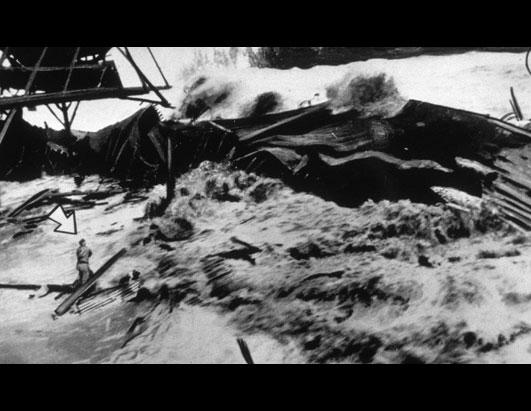
Looking back, part of what made tsunamis frightening was was that I didn’t know what they looked like, and my imagination ran wild filling in the gaps. I read what I could find about them. In particular, I remember being just old enough to work my way through this book, and carrying it around with me so I could read the tsunami section over and over. It included a grainy photo of a ship in a Japanese harbor plowing through an unimpressive-looking line of breakers. I think that’s also where I found a photo of some people running away from something (it was this photo, but the reproduction in my book was too grainy to see what they were running from).
Years later, after the rise of the web, I realized maybe I could now find a video of a tsunami, and finally see the thing that had so captivated me as a child. But my searches for videos didn’t turn up much of anything.
Then the 2004 tsunami happened. Shortly after, as YouTube and its various clones proliferated, there was more horrifying footage available than I could handle.
A year or two ago, I read an article somewhere (I have tried to find it again with no luck) which mentioned that before 2004, there hadn’t been much in the way of photographic or video records of tsunamis, and that this had contributed to a lack of understanding of their form. My childhood impression seemingly confirmed, I worked this into a comic.
It turns out I was mistaken. There are several photographs, some of which can be seen here, here, and here. There’s also a video here (sent in by Phil Plait).
I think what confused me as a child was that none of the photos showed the wave I expected—just debris, and occasionally some visible water. Now that I’ve seen horrifying videos like this, I’ve gone back to some of those old photos and realized that they did show a tsunami. It was just so unlike what I was expecting that I didn’t recognize it.
So thank you to everyone who sent in information. It’s really fascinating stuff. Oh, and anyone interested in the history of tsunamis might want to check out a Google Books advanced search for material published before 1850 containing phrases like earthquake wave, earthquake tide, or earthquake water feet. There are some gripping historical accounts buried there, along with some really interesting speculation by 19th-century scientists about the mechanisms behind earthquakes and their associated waves (the consensus seemed to be hot gas moving between subterranean chambers).
 xkcd
xkcd 

“I would fret about tsunamis *them* whenever”
LikeLike
that’s some powerful grammar mistakes.. i stopped counting after half a dozen.. 😉
LikeLike
Jeff and Tom: fuck die and off.
LikeLike
Sorry! I removed the extra “them” (the sentence got jumbled when I went back and edited it). I haven’t spotted the other mistakes you mentioned.
LikeLike
To actually, you know, talk about what was said (rather than nitpicking how it was said) – interesting! It reminded me vaguely of an interview I once read with Paul Chadwick (creator of the horribly under-appreciated comic “Concrete”). The character (a human mind in a lumbering, unfeeling, stone body) came from his childhood fantasy/fears of being trapped in a landslide or cave-in.
Maybe it was just the comic-book refrences in the comic that triggered it.
The fear of the earth “turning against you” is powerful. In the back of our minds we know (but don’t like to remember) that these sweeping, cataclysmic events are just as “natural” as anything else and that we (and all our works) are completely insignificant when compared to the least of them.
LikeLike
I think what boggles my mind re: tsunamis is the disconnect between my brain’s physics simulator and what I’m seeing on the screen. It just looks like water from a hose creeping across pavement, picking up debris — but the debris in this case is houses. I think the disconnect here lies with the fact that the tsunami has exactly the same shape as the front of water from the garden hose I left on, and I incorrectly transfer all my knowledge of the latter to the former.
(I didn’t see any other spelling or grammar mistakes, I think you’re good.)
LikeLike
Honestly, the image of a scared little child carrying around a book about tsunamis so he could reassure himself by rereading it is adorably sad.
LikeLike
I find this fascinating too!
LikeLike
You were obsessed with tsunamis. I was obsessed with volcanoes, thanks to my grandfather reading me the story of Pompeii. The idea that a volcano could just spring up and erupt – horrible! In my imagination there was the real possibility that this giant cone of rock would thrust itself up from the earth anywhere, any time, and bury us all in hot lava.
Then I became convinced that what I needed to do was to survive somehow in a pocket of air until archaeologists could chip me out…. so I went to sleep every night with the covers over my head, suffocating in the heat, sipping little bits of cool air through a little “escape hole” every so often.
LikeLike
What I personally find interesting in your post is the fact that the lack of visual information had/has such a severe impact on your and other peoples perception.
You wrote you read the tsunami part over and over but still there was this strange fears and dreams. This may be an isolated case but it seems like fact-driven knowledge without any visual impression is worthless. Not necessarily worthless but it leads to no understanding.
As a designer I work with every visual tool that is able to communicate, on a daily basis, but stories like your one show, that what we take for granted – an image for every fact – is what makes us understand. Or on the opposite: A lack of pictures leads people to fear of the unknown, no matter the scale.
LikeLike
@Gerulf: Of course, we are talking about a child’s mind here.
LikeLike
Additional mistake:
“When I was a kid, I *was had* an irrationally powerful…”
LikeLike
I think that most people have been influenced heavily by Hokusai’s famous print “Great Wave off Kanagawa ” which has often been mis-identified as a tsunami.
LikeLike
Fun Fact: Charles Darwin describes a Tsunami in his “Voyage of the Beagle”.
LikeLike
I’ve always viewed tsunamis as the drawing in this Magic the Gathering card: http://www.chicagonow.com/art-talk-chicago/files/2011/06/Tsunami.jpg
LikeLike
Now to complete the horror, we’ll need a comic about Velociraptor surfing on tsunamis while hacking your server one handed and dumping your database tables, revealing the 74 poems about your ex, written after the break up, which alternate between the various stages of grief.
LikeLike
I went through similar things. Back when I was a kid, I read books about natural disasters, and tsunamis in particular, and they were certainly portrayed as huge breaking waves. I think I even remember a black-and-white photograph of something that looks like a wall of water approaching the beach (can’t find it on the web though).
Horrible as it was, I was almost “disappointed” in 2004 by how “unspectacular” they really look. At times indistinguishable from a river flooding breaking a little dam. How can something this terrible look so innocent?
But then again, don’t all warning signs on beaches (at least in Japan) show a breaking wave? Don’t all (semi) scientific illustrations show a wave becoming slow and tall as they approach land? You know, the whole “wavelength goes down, amplitude up, wave becomes slower” thing? Doesn’t it also make sense mathematically?
So the question is really: why do tsunamis actually look like the one in 2004 (and the other more recent ones)? Why do they NOT look like the ones in our childhood nightmares?
LikeLike
@Danyal: lol.. 😉
i didn’t wish to be pedantic, it was just distracting..
@xkcd:
“When I was a kid, I was had”
“part of what made tsunamis frightening was was”
now, i am not a native English speaker, but i did grow up on MTV, US sitcoms and i graduated from a UK university..
still, i may be wrong..
so i googled: http://english.stackexchange.com/questions/31355/what-does-i-was-had-mean
LikeLike
Grammar police, police thyselves. The plural of “tsunami” is “tsunami.”
LikeLike
@yoshi You said “Grammar police, police thyselves. The plural of “tsunami” is “tsunami.””
I’m not asking this to be pedantic, but because I’ve never seen that form before, but… can you have a plural form of “thyself”. Thee/thou/thy/thine are archaic forms of “you” meaning a singular “you” (to be contrasted with the plural “you” implied in the phrase “you all”)
So I’m just wondering about the use of thy and self in that context.
Thus, I can see that “yourself” in this context would be an inherently ungrammatical form (unless you were talking to the borg? Or are you not allowed to use the idea of ‘self’ with the borg at all?) but would the plural form of “thyself” be “thyselves” or “yourselves”?
If I were posting this anywhere else, I might apologize for geeking out, but I hardly think that’s necessary. ^_^
LikeLike
Indelible scene from an otherwise crappy movie: the classic, HUGE breaking wave in “Krakatoa, East of Java” (the fools even got the title wrong; Krakatoa is WEST of Java; but whatever). Equally disturbing for me were/are the reports of rogue ocean waves; like Randall, I spent a lot of time at the shore, wondering, but no way in hell are you gonna get me out in open water, no matter how big the ship (and ESPECIALLY not if Gene Hackman and Shelly Winters are on board). Still, it is weirdly fun to scare the crap out of oneself from the safety of a computer far inland, watching flaming waves and such. Just glad the Mississippi didn’t give way last year, along with another Katrina. Hurricanes, flames AND alligators: oh boy!
LikeLike
As a child, I also was terrified of tsunamis. I was told very early on about drawbacks (I guess this part was pretty much true) and would constantly eye the shoreline to make sure a drawback wasn’t happening: http://en.wikipedia.org/wiki/Tsunami#Drawback
Also, I was terrified of whirlpools forming in lakes. The concept of whirlpools appears to be heavily exaggerated in fiction as well. I still have dreams about all these wacky and irrational things and of course a healthy stream of dreams about nuclear bombs and zombies.
By the way, I’m amazed that people still pick apart grammar and spelling when the topic of discussion is actually a comic ridiculing such pedants. Tsunamis is an acceptable plural form of tsunami in English.
LikeLike
@Rowan A quick internet search tells me that thy and thou were only used to address one person. The plural is your/ye, so the “correct” form would be yourselves. Not that anyone would be too confused of you used thyselves.
LikeLike
I remember, as a child, hearing the story of a village in Mexico, where some children discovered smoke coming out of the ground, later discovering that a brand new volcano was forming in the field where they were playing. I have no idea if this story is truth or fiction, but the concept definitely scared me.
At one point, I thought this was the story of how Popocatépetl (http://en.wikipedia.org/wiki/Popocat%C3%A9petl) formed, but after learning more, I realized that it couldn’t be (although perhaps it is some folklore/legend about how Popocatépetl came to be.)
Does anyone know more about this story? I haven’t been able to come up with Google keywords to produce a reference.
LikeLike
Nevermind. Shortly after writing my post, I did some additional Google searching and discovered the source of the story I heard. It’s Parícutin (http://en.wikipedia.org/wiki/Par%C3%ADcutin) not Popocatépetl.
Scary.
LikeLike
When I was a kid in the 60’s my biggest recurring nightmares were bombs dropping on me in the middle of the night. Parents don’t let your kids watch war movies or play war games. I think I was had but that depends upon what your definition of what was was.
These days i just have occasional daymares of mushroom clouds on the horizon. And nightmares of having to work once again in a city of more than 100,000.
LikeLike
Semi-relevant: I wrote a research paper once about the psychology of the apocalypse and published it on my little used blog — excuse me — blag: http://fuckyeahsynesthesia.tumblr.com/post/5393518448/psychologically-why-do-we-believe-in-apocalyptic
(it’s not the best writing, but the ideas are cool)
LikeLike
David C.:
Thanks for reminding me of the story of Parícutin. I remember reading that story as well when I was a child, but I thought having an active volcano spring up in your backyard would be awesome, not scary.
The things that scared me as a child were oddly prosaic; basically, car crashes and house fires. This came up in FARK thread earlier this week; I remember the old Reader’s Digest use to run photo spreads showing the aftermath of highway accidents, and I remember being morbidly fascinated by them and, at the same time, being afraid to look at them.
As for house fires, I grew up prior to the invention of the smoke detector. I think my family got our first one when I was 10 or 11. And I remember what a feeling of relief it gave me. In retrospect, the smoke detector may have been one of the unheralded triumphs of the 20th Century; you hear people talk about antibiotics and airplanes and automobiles, but you never hear anyone talk about the number of lives saved by smoke detectors.
LikeLike
For me it was tornadoes; I’m sure The Wizard of Oz didn’t help, but the main thing that contributed to my still-recurrent terror of them was a very early memory of stopping in an Ohio town on a cross-country trip and hearing a tornado siren go off. That was bad enough, but then I saw a woman hurrying through the street dragging another little kid, tears running down the woman’s face, and how the town went silent while we just stood there in a restaurant parking lot.
Turns out part of the town had been leveled the year before by a tornado. For us, it was a false alarm, but for the residents it was a reminder of a Very Bad Day.
Oh, and by the way, please put a post up where people can suggest baby girl names. To compliment little boy Drop Table, why don’t we add little girl Insert Into.
LikeLike
Dwight Brown,
The thought of house fires terrified me as well when I was young. This fear was engendered in part by countless presentations in elementary school by local fire departments about how to escape burning houses safely and was confirmed when a classmate’s house burned down. I would pester my parents to check fuses and electrical outlets and fell asleep every night replaying my escape plan in my head.
So in middle school, when the class was assigned a report about great inventions of the twentieth century, I wrote about the smoke detector, probably boring my airplane-and-automobile-loving classmates to tears.
Now, I’m more afraid of tornadoes, though I’ve never encountered one.
LikeLike
I’m sure you already realized it but this file http://en.wikipedia.org/wiki/File:Tsunami_large.jpg and the first picture on this site http://www.pbs.org/wnet/nature/episodes/violent-hawaii/deadly-tsunamis/1862/ are the same picture, the one on the pbs site is just a tighter crop.
LikeLike
@David C – I remember that story! But I hadn’t until I read your post – gave me a little shiver, that did. Now I have to go read your link, so thank you!
Interesting point about the smoke detectors. When I was a kid, I had a fear of fire from watching too much Emergency. Tornadoes weren’t scary because they would transport you to Oz, but those flying monkeys were/are a different story altogether.
LikeLike
@Lauren’s Holst:
It doesn’t really matter if it’s a child’s mind. A child’s fear and experience is what the adult mind is made of.
LikeLike
Just wanted to say, Etymology Man is one of your best characters. Please allow him to show his face on a regular basis.
LikeLike
I have regular dreams wherein I’m driving along the road minding my own business, look in the rearview mirror, and realize that the entire sky has been replaced by an enormous, several-thousand-foot high wave. I live in a city that is bisected by a mountain range (in the desert, I might add), and in these dreams, the wave is coming over the mountains and blotting out the entire sky.
I don’t have many nightmares as an adult, but that one will leave me shaking for days. It’s especially weird because, as I mentioned, I live in the West Texas desert. It’s not even remotely realistic or plausible. But it sure is stuck in my psyche…
LikeLike
@xkcd: if you are really interested in finding that article you were looking for…(you’ve probably tried this, but i have to ask…) have you tried going to a librarian? do you remember any information about it (year published, where you saw it, initials of the author, a random phrase in the title or main text….)?
i’m in library school now (hopefully will graduate in August), and I wouldn’t mind having a go at finding your article. 🙂
LikeLike
When I was a child, I heard about another family in our city who’d lost a child to a fire. I was horrified that our house would catch fire at night. I don’t think I lost that fear until I was a substantially older teen.
LikeLike
“But then again, don’t all warning signs on beaches (at least in Japan) show a breaking wave? Don’t all (semi) scientific illustrations show a wave becoming slow and tall as they approach land? You know, the whole “wavelength goes down, amplitude up, wave becomes slower” thing? Doesn’t it also make sense mathematically?
So the question is really: why do tsunamis actually look like the one in 2004 (and the other more recent ones)? Why do they NOT look like the ones in our childhood nightmares?”
the system is highly turbulent and non-linear – it’s no good going with approximations. (A random guess: with large velocities/momenta/etc the surface tension of water is not much good at holding a shape)
LikeLike
@Rowan, “thyselves” would not be understood in 17th century England, thy is exclusively singular, however by analogy with yourselves its contemporary usage is generally accepted. geek!
I remember every depiction of a tsunami in my childhood look something like this, http://shrt.htmltw.co.uk/wave
James
LikeLike
hi, my name is vince and i own a blog on google on yeast infection natural, treatment. My articles are unique and serious. I dont know what it takes to be part of your author list but im ready respond to your request.
vince van uytfanck
LikeLike
sunami never care to our people
LikeLike
When I was in high school, I had the pleasure of a lazy geography replacement teacher. The guy didn’t like his job, so most of the time we had to watch boring videos. However there was one very nice video I saw, about the island La Palma (Spain) that is divided into two parts. When the underlying volcano would erupt, the island would split, causing a massive landmass slide into the sea. This would result in a tidal wave that hits the complete east coast of North and South America, going more than 25km land inwards. They named it… mega tsunami. Next (or before) they investigated evidence of such other tsunamis.
I saw this in 2000, 4 years before the “first public tsunami”. I looked it up, it was a BBC Horizon episode:
http://www.bbc.co.uk/science/horizon/2000/mega_tsunami.shtml
Surprisingly, it is on youtube: http://www.youtube.com/watch?v=zKSlWLKdrFI
Note the dates: in 1958 there were already talks of tsunamis.
LikeLike
I was always afraid of earthquakes as a child. Then we actually had one, and I was almost killed by a collapsing building, and while everyone else was freaking out at the slightest tremor or aftershock, I felt calm. Perhaps my confronting of the unknown (i.e., how the ground shakes, how long, how strong, etc.) gave me more certainty about what to expect in future. But now I’m scared of plane crashes. I just think about all the thousands of components on an aircraft whose failure would mean certain death for its passengers.
LikeLike
When I first saw tsunami video footage, I couldn’t really wrap my head around what was happening – it was all shot from the air and at a distance, and my mind couldn’t connect the little objects on screen with real things like cars and buildings being swept away. It all seemed rather unimpressive; just a thin layer of brown pushing blurry white boxes. Then I saw this: http://www.youtube.com/watch?v=ceym2c18OQM&feature=related
And that’s when I understood just how powerful and terrifying an event these things are. To me, it’s way worse than the stereotypical image of a big, breaking wave that hits and then is gone. A real tsunami is like the whole ocean coming to swallow everything in front of it. It doesn’t stop, it just keeps coming. I’ve seen it a dozen times and that video still freaks me out.
LikeLike
Actually, tsunamis may indeed look like a “breaking wave” (or a “wall of water”) when arriving ashore. It depends mainly on the structure and formations of the coastal line. I think it is a rarer phenomenon, though. There are videos documenting it, nevertheless.
Look at Koh Lanta tsunami video, from the same 2004 tsunami you are talking about: http://youtu.be/0NfKZAiWRoE ; In this one, too, you can briefly see the “formation” of the wave as it approaches land: http://youtu.be/yBQzQGcKDE8
About the recent Japan tsunami, the same phenomenon was reproduced in some areas. Look at the videos below: huge walls of water, breaking waves…
But I think this one is the most terrifying: http://youtu.be/yiENf1f1tIA
Also, read the “Phases and wave form” section of the 2004 tsunami Wikipedia article: http://en.wikipedia.org/wiki/2004_Indian_Ocean_earthquake_and_tsunami
LikeLike
I do like the fact that Tsunami understanding has come a long way…. what I find interesting are mega-tsunamis that occur with large displacements of water (what you would classically find in old stories and popular imagination.
Good example of that is here; http://en.wikipedia.org/wiki/1958_Lituya_Bay_megatsunami
🙂
LikeLike
If you want to know why tsunamis havent really happened before 2001, you may want to find out about weather modification and the machines the global elites are using to create tsunamis. It’s all about depopulation to them. We are just chicken feed and lab rats to these people. Look up “haarp” and find the truth!
LikeLike
FISTBUMMPPPP!! Thank you for the awesome cartoons. I thought I’d try reaching you here which will probably fail. 😀
LikeLike
I came across a section of Herodotus the other day when reading about the battle of Plataia which describes part of the Persian army being destroyed by a tide tgat went out exceptionally far and then came in very fast. Sounds like a tsunami and at 480 BC might one of the earliest ‘scientific’ descriptions.
LikeLike
That’s cruel and horror..
LikeLike