Last year I drew a comic about the oil spill in which Michael Bay spun an over-the-top worst-case disaster scenario. One of the panels was actually slightly more plausible than the others. It was based on a real disaster which almost happened in 1973, and in two weeks it may come closer to happening than ever before.

I learned about this from John McPhee’s The Control of Nature (adapted from this article), a book that my mom gave me as a kid (Happy Mother’s Day!). I’m not any sort of an expert on the subject, but here’s what I’ve learned so far:
Every thousand years or so, the lower Mississippi changes course. It piles up enough silt at its delta that it ‘spills over’ to a new shortest path to the ocean. At times, the outlet has been anywhere from Texas to the Florida Panhandle.
Since the early 20th century, the Mississippi has been trying to change course again—sending its main flow down the Atchafalaya river, which offers a much shorter, steeper path to the ocean. The Army Corps of Engineers was ordered by Congress to keep that from happening. The center of their effort is the Old River Control Structure, which limits the flow down the Atchafalaya to 30%.
Every now and then there’s a massive flood which stresses the system. The fear is that if the Mississippi ever broke through the ORCS and the main flow was captured by the Atchafalaya, it would be very hard or virtually impossible to return it to its old route. This would devastate the people and industries around in Baton Rouge and New Orleans who depend on the river (as if they haven’t had enough problems lately). This almost happened in 1973, when a massive flood undermined the structure; this was the subject of John McPhee’s book.
They’ve since strengthened the structure, but the coming flood is quite a bit larger than the one in 1973. In order to save New Orleans and Baton Rouge, they have to send some of the floodwaters down the Atchafalaya.
Here is the working plan for routing the water from a nightmare flood:

The Mississippi River Commission document outlining the plan is here.
This plan, put together after the devastating 1927 floods, is based around the estimate of the largest possible flood the Mississippi could ever experience. In theory, the system is capable of handling such a flood, although much of it has never been put to the test.
The current flood moving down the Mississippi is going to stress this system to near its limit. Here’s a version of that map with the current flow rates, with the approximate expected coming flood shown at the top:

This is based on the diagram at the ACOE Mississippi River page, which is updated daily with new flow rates.
The floods above the system are expected to crest 6′ higher than in the 1927 flood, the highest in recorded history, and 7′ higher than the 1973 flood that almost destroyed the ORCS. Here’s the gauge just above the structure as of noon on May 8th:
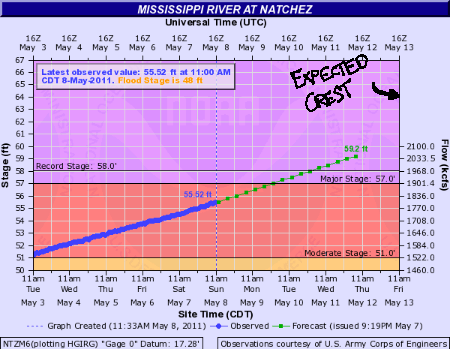
The current Natchez gauge can be seen here.
The Morganza spillway has only been opened once (to take the stress off the failing ORCS in 1973), and then only partly. It’s fairly clear at this point that the Morganza spillway and the Bonnet Carré spillway will both be fully opened to route the flow away from New Orleans (which is expected to crest just a few feet below the tops of the levees there).
I have no idea how likely the Old River Control and Morganza structures are to fail, or whether a rerouting of the Misssissippi through a new channel would be irreversible. You can read some speculation on this here.
Additional resources:
Wunderground blogger Barefootontherocks maintains a page full of resources on the current Mississippi flood, and there’s a lot of information in the comments. The excellent Jeff Masters will probably have a post on the subject in the next few days. You can see more gauges and a ton of information at the NWS page on the lower Mississippi.
Michael Bay can be reached here.
 xkcd
xkcd 
Someone please update http://en.wikipedia.org/wiki/2011_Mississippi_River_floods
LikeLike
@A lil birdie Thanks for the clarification. That was an interesting article and I might just have to pick up John Barry’s book.
@Raphael Unfortunately too many lives would be devastated by New Orlean’s loss of access to the main flow of the Mississippi and the fact is we simply have too much infrastructure invested in the city to simply abandon it. Humanity has a consistently short sited view of development. They can accomplish great things, but frequently their accomplishments are only designed to last as long as people will remember those who have made the accomplishments. All we can realistically do now is compensate for our shortsightedness the best we can.
@Diadem Along that vein, I think the ACE started in the 1940’s building man made lakes along the tributaries to the Ohio river in an effort to control flooding. It’s been a learning process, but they do seem to be getting better at it.
@Adam Hey fellow Paducah resident! Are you going to OMG con in June?
LikeLike
Interesting. This is quite obviously Allah’s retribution on us for killing his devoted leader, Osama.
LikeLike
This is clearly justified revenge for the people who said that the tsunami was justified revenge for Pearl Harbour.
LikeLike
I travel across the Mississippi River from West Memphis to Memphis twice a year, to go visit my father, and because of the massive flooding, for the past two years, I haven’t been able to go… I still don’t have anyone to blame for the previous year, ‘Lake Nashville’, but now I have someone to blame for this one!
THANKS, AMERICAN GOVERNMENT!!!
LikeLike
Well, when you took your screenshot the latest data was 11:00 AM Sunday. At that time, the prediction for 11:00 PM Monday was right at the “Major Flood” mark, 57′. Well, we now have the 11:00 PM Monday reading, and it’s at 56.97′. This is (unfortunately) looking like their predictions are right on.
We can only hope that your prediction from last year is wrong…
LikeLike
Does anyone have information on what the plan is if the Old River Control Structure IS destroyed? Is the plan to try to repair it and re-divert the Mississppi back through New Orleans? (If so, how does one do that, civil engineering-wise?) Or is the plan to move the port / industries to the new mouth? (If so, what is involved in doing that?)
LikeLike
You’d first have to build a massive diversion channel bypassing the ORCS, then “convince” the river flow to follow your new, longer, less-sloped diversion channel. Probably not impossible, but likely to be one of the most expensive public works projects of all time.
LikeLike
Completely OT: took me a while to find the Ω key; captcha “FΩ arFratel”
LikeLike
Half a century ago when the decision to build the ORCS was made it was felt that if the Mississippi did change its route it would be impossible to divert back. It’s possible we could do so today, but it would be an enormous undertaking’ and would almost certainly take so long that most of the spending needed to adapt to the loss of the river would need to be done anyway.
LikeLike
Shit just got real…
LikeLike
According to Mark Twain in “Life on the Mississippi”:
“The town of Delta used to be three miles below Vicksburg; a recent cut-off has radically changed the position, and Delta is now two miles above Vicksburg.
Both of these river towns have been retired to the country by that cut-off. A cut-off plays havoc with boundary lines and jurisdictions: for instance, a man is living in the state of Mississippi to-day, a cut-off occurs to-night, and to-morrow the man finds himself and his land over on the other side of the river, within the boundaries and subject to the laws of Louisiana! Such a thing, happening in the upper river in the old times, could have transferred a slave from Missouri to Illinois and made a free man of him.
The Mississippi does not alter its locality by cut-offs alone: it is always changing its habitat bodily–is always moving bodily side-wise. […] Nearly the whole of that one thousand three hundred miles of old Mississippi River which La Salle floated down in his canoes, two hundred years ago, is good solid dry ground now.”
Seriously, nobody in government has ever had to read.
LikeLike
The river will shift eventually… again and again. It’s a river and it isn’t possible to keep it in the same place forever. But, this would be a bad time for it to shift.
Our recent flood problems aren’t just about floodplain development, though that is a big issue. The problems are also directly related to destruction of riparian corridors (the forests along rivers) and wetlands way up in the upper regions of the watershed. Remember, almost none of the water in these rivers comes from rain/snow that falls directly into the rivers. It all comes from areas upstream, and abuse of these areas (compacted soils, concrete, ditches around farms) that speed up water flow lead to nasty floods downstream.
Build a rain garden!
LikeLike
Also it’s worth noting that people in the delta have been trying to get support and funding for restoration of a more natural flood regime on the Mississippi for quite some time… but there is no support for this. No one wants to pay for wetland restoration, because they don’t see the direct economic benefit. This isn’t just a bunch of ‘hippie treehugger’ stuff, like someone posted earlier, much of our energy infrastructure is in this area as well. We’ve been abusing the delta in many ways, and we are paying for it in many ways as well.
LikeLike
@ Wolby:
Rerouting rivers to an existing riverbed is really not that hard. You just have to dam off the spot where it branched off, and the old flow will restore itself. America is not known for its skill with waterworks, but this is really low tech stuff. It will take a while, obviously, but it’s not that hard, and compared to other major engineering works not very expensive either.
Of course that won’t undo the damage done by the river changing course temporarily, which will be massive. So it’s a good idea to make sure the ORCS doesn’t fail. All I’m saying is, that if it does, this doesn’t mean the river flow is now permanently altered.
Here in The Netherlands an old cold war area defense system involved rerouting one of the biggest rivers of Europe. This could (presumably) be done faster than Russian tanks could cross Germany. The river Rhine splits into three branches in The Netherlands, two branches going west and the smallest, The IJssel, going north, carrying about 1/9th of the flow. The plan involved 3 dams. Two to completely block off the two major branches, forcing all water through the IJssel. The third dam was actually in the middle of the IJssel itself, a bit downstream, to make sure it would flood.
It’s actually a fascinating story. The entire project was built in secret. Had it been used, a significant part of the country would have been inundated, half a million people would have had to evacuate, and several million more people on the wrong side of the river would basically have been abandoned to the Russians. All this to protect the single most important strategic area in all of Europe, the ports of Rotterdam and to a lesser extend Antwerp.
It worked. The Russians never attacked 🙂
LikeLike
Diadem: You’re missing a major scale factor. The Mississippi’s average discharge volume is is over 9x larger than the Rhine’s average.
LikeLike
This post could easily be from bldgblog.blogspot.com. I think Geoff might enjoy it.
LikeLike
@Zach Don’t be like that. You don’t have to mock a huge religion just because of one big corrupt leader. We don’t mock Christians for Hitler, and yes, it’s pretty much the exact same situation.
Besides, the path of the Mississippi changing isn’t going to destroy the whole country (probably not at least). If I had to predict, I’d say people would desert the affected cities ASAP, and those left would remodel the cities to be less river-oriented.
LikeLike
Wasn’t there a Clive Cussler book about this?
LikeLike
@Diadem,
We’re talking about the largest river in North America, and one of the largest rivers in the world (4th overall IIRC, but it all depends on how you measure I suppose.) I’m not sure we can engineer a damn big enough to divert it, nevermind the expense and logistics of building it.
I live in St. Louis, where the river altering really begins (above that the river isn’t diverted as much). It’s a nightmare just to keep it from claiming back parts the surrounding area at times. And we’re only at the halfway point (and above it’s largest tributary, although the Missouri isn’t anything to sneeze at.) By the time it hits NO, it’s an unstoppable force of nature.
LikeLike
@ everyone suggesting we dam/divert the river back… at great expense we CAN do this… but not forever. Unless you can remove all sediment from the muddy Mississippi (impossible), the old channel will increasingly be filled with silt as it fills in its part of the delta. Dredging costs will get higher and higher. Meanwhile the rest of the delta slowly sinks, due to natural compaction of sediment. Eventually even if you kept the river there everything else around it would be gone… and the delta-building sediment dumped uselessly over the continental shelf.
Short term, we all hope the Old River Control Structure doesn’t break during a flood… that does no one any good. Longer term, I’d guess the only real option is to keep the ‘old’ Mississippi intact as a sort of canal, divert enough freshwater down it to feed the industry, and divert the rest down the Atchafalaya. Right now the bottom part of the river, where most sediment is transported, dumps down the old Mississippi river, deposits its silt, while the less silty flood overflows into the Atchafalaya erode its channel deeper (rivers with less sediment in them can pick up more sediment, thus causing flooding). We need to reverse this so that the sediment-rich flows go down the Atchafalaya and build delta/wetlands. This will also decrease damage from hurricane storm surges, restore the fishery, etc, etc, etc. The problem is, this all costs money, and no one wants to pay for delta restoration when the floodwaters aren’t rising.
LikeLike
oops, “(rivers with less sediment in them can pick up more sediment, thus causing flooding)” – replace flooding with erosion…
LikeLike
@Mahmoud Mock away. Fair’s, fair.
LikeLike
Velociraptor Cloaca,
We can only hope that someone with a view of the situation as clear as yours will someday be in a position to do something about it.
What’s certain in all of this is that Mr. Monroe has a very cool mother (and I was reading entirely different books about orcs at that age…). This strikes me as an ironic juxtaposition of a miracle of modern engineering, something we probably shouldn’t have done, and a disaster waiting to happen. I hope we can figure out how to fix it before some sort of bifurcation occurs…
LikeLike
Thanks for the post, Michael. Like you I’m no expert in this stuff. I just wanted to add that the McPhee article you linked to quotes a geologist that at the time was working at the NO HQ for US Army Corps Engineers. Maybe he’s still there, I don’t know. Anyway, that article quoted this guy as saying that the river wants to jump course and it might do that someplace other than the dams and spillways…. in other words, upstream of the ORCS, where the water will be high and (as I understand it) the soils are soil not rock, so the river could decide to cut its own new channel upstream of ORCS. In terms of how fast technology advances that article was fairly dated…. almost 25 years ago! Beats me what they might have done since then to fortify the upstream levees and banks. I’m just saying that the risk is not purely to the massive concrete feats of engineering. The water will erode what it can, and look for the easiest way to the sea. Its a steep drop down the Old River / Atchafalaya River drainage, compared to the silt-filled channel Ol’ Miss has been using the last 1000 years. Hopefully the corp’s work will succeed, but part of me thinks the mission was quite literally impossible for anyone to pull off over the longterm. Time will tell.
LikeLike
Thanks for enlightening us on a very troubling situation. “they’re trying to wash us away” by Randy Newman is ringing in my ears again. Now I have a clearer picture of what he was talking about.
LikeLike
We have rerouted one ‘escaped’ river in the United States, the Colorado river in 1905 jumped, during a flood, from its natural channel into a manmade canal and created the Salton Sea (http://en.wikipedia.org/wiki/Salton_sea#Creation_of_the_current_Salton_Sea). The Colorado is a major river, while certainly smaller than the Mississippi, it was eventually put back into its natural channel over two years. Modern machines and technology I suspect could do the same to the Mississippi in a similar time frame.
LikeLike
Here is a nice graphic that puts the worst-case flooding scenario into perspective (for this flood): http://media.nola.com/weather_impact/photo/map2-morganza-051111jpg-0ad237fba02ef817.jpg
Parts of New Orleans under 25′ of water if Morganza isn’t opened.
LikeLike
Clive Cussler had a plot with this in it, although his involved an ocean liner and illegal immigrants from China. (Flood Tide)
LikeLike
First Debt of Honor, now Flood Tide! When will techno-thriller authors learn to stop writing books?
LikeLike
“…1973 flood that almost destroyed the ORCS…”
But they bred with goblins and got away!!
LikeLike
@diadem it worked?
they built dams in secret to stop the russians if they attempted to attack. for this to have worked the russians would have to attempted an attack. your story says they didn’t.
And your story suggests that the russians they didn’t know about the dams cause they were a secret, so they must have had other reasons not to try an attack.
therefore the dams were a complete waste.
LikeLike
Thanks for all the resources.
Does anybody know of a resource that will show what AREAS of cities are expected to see flood waters? My grandmother lives in Vicksburg, and I’m not familiar enough with the area to equate “58 feet” with what is or isn’t underwater at the time.
LikeLike
@R. Sue
You could check a topo map, e.g.
http://mapper.acme.com/?ll=32.33000,-90.90000&z=13&t=T
LikeLike
lookit this map for the course of the M. over millenia:
http://www.boingboing.net/2010/05/13/visualizing-the-cour.html
LikeLike
Your mom sounds awesome.
Thanks for another enlightening article. And a belated thanks for your radiation chart — I spent hours searching the Internet trying to understand all the numbers being thrown around about Fukushima, until my son sent me a link to your blog.
LikeLike
we need to quit trying to fight nature, and learn to live in harmony with it. If some people hundreds of years ago made a handful of bad decisions, oh well. it sucks to be them. They have to deal with it, and perhaps learn from their mistakes.
LikeLike
This is fantastic. I had no idea I love watching river gauges this much. Thank you thank you. And what happened in Burlington, VT?
LikeLike
Lake Champlain at Burlington has dropped a bit but is still above flood stage. Unfortunately we are expecting 3 inches of rain this week so it may rise again.
LikeLike
You know what’s awesome? That we have the science to be able to predict the height and extent of a flood like this weeks in advance, and the technology to do something about it.
Also, I note that the crest is supposed to be around May 21, which is when those religious doomsayer people are saying the Apocalypse is supposed to arrive (or whatever it is they’re claiming).
LikeLike
Perhaps the current approach isnt the best solution ? I mean.. maybe a good planning and working together (and not against) the nature would end up being MUCH better long term solution.
I know, it would be a Utopia since there isn’t any politician risking their entire career in something like this..
LikeLike
Sorry this is more about your most recent comic… It’s just that 8 isn’t prime.
LikeLike
Randall, I’ve trying to reach you about the possibility to feature one of your pieces in an independent Mexican magazine. what can I do? Thanks a lot, we really appreciate your time!
LikeLike
@Eric
… and neither is a negative number an “imitator” number, or .99… = 1-3.72*10^(-8), or the area greater than 2 the “forbidden region”, or the numbers between 4 and 7 unexplored, etc.
I think that’s why this is “A webcomic of romance, sarcasm, math, and language,” and not “A series of facts that are all to be taken seriously.”
Anyways, there are forums to discuss comics, this is supposed to be for thing relating to the blagopost.
🙂
(^obligatory emoticon to show I am trying to be helpful, and not an ass)
LikeLike