Last year I drew a comic about the oil spill in which Michael Bay spun an over-the-top worst-case disaster scenario. One of the panels was actually slightly more plausible than the others. It was based on a real disaster which almost happened in 1973, and in two weeks it may come closer to happening than ever before.

I learned about this from John McPhee’s The Control of Nature (adapted from this article), a book that my mom gave me as a kid (Happy Mother’s Day!). I’m not any sort of an expert on the subject, but here’s what I’ve learned so far:
Every thousand years or so, the lower Mississippi changes course. It piles up enough silt at its delta that it ‘spills over’ to a new shortest path to the ocean. At times, the outlet has been anywhere from Texas to the Florida Panhandle.
Since the early 20th century, the Mississippi has been trying to change course again—sending its main flow down the Atchafalaya river, which offers a much shorter, steeper path to the ocean. The Army Corps of Engineers was ordered by Congress to keep that from happening. The center of their effort is the Old River Control Structure, which limits the flow down the Atchafalaya to 30%.
Every now and then there’s a massive flood which stresses the system. The fear is that if the Mississippi ever broke through the ORCS and the main flow was captured by the Atchafalaya, it would be very hard or virtually impossible to return it to its old route. This would devastate the people and industries around in Baton Rouge and New Orleans who depend on the river (as if they haven’t had enough problems lately). This almost happened in 1973, when a massive flood undermined the structure; this was the subject of John McPhee’s book.
They’ve since strengthened the structure, but the coming flood is quite a bit larger than the one in 1973. In order to save New Orleans and Baton Rouge, they have to send some of the floodwaters down the Atchafalaya.
Here is the working plan for routing the water from a nightmare flood:

The Mississippi River Commission document outlining the plan is here.
This plan, put together after the devastating 1927 floods, is based around the estimate of the largest possible flood the Mississippi could ever experience. In theory, the system is capable of handling such a flood, although much of it has never been put to the test.
The current flood moving down the Mississippi is going to stress this system to near its limit. Here’s a version of that map with the current flow rates, with the approximate expected coming flood shown at the top:

This is based on the diagram at the ACOE Mississippi River page, which is updated daily with new flow rates.
The floods above the system are expected to crest 6′ higher than in the 1927 flood, the highest in recorded history, and 7′ higher than the 1973 flood that almost destroyed the ORCS. Here’s the gauge just above the structure as of noon on May 8th:
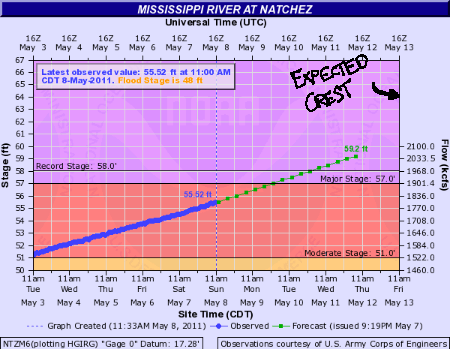
The current Natchez gauge can be seen here.
The Morganza spillway has only been opened once (to take the stress off the failing ORCS in 1973), and then only partly. It’s fairly clear at this point that the Morganza spillway and the Bonnet Carré spillway will both be fully opened to route the flow away from New Orleans (which is expected to crest just a few feet below the tops of the levees there).
I have no idea how likely the Old River Control and Morganza structures are to fail, or whether a rerouting of the Misssissippi through a new channel would be irreversible. You can read some speculation on this here.
Additional resources:
Wunderground blogger Barefootontherocks maintains a page full of resources on the current Mississippi flood, and there’s a lot of information in the comments. The excellent Jeff Masters will probably have a post on the subject in the next few days. You can see more gauges and a ton of information at the NWS page on the lower Mississippi.
Michael Bay can be reached here.
 xkcd
xkcd 
There’s been a lot of local coverage here (http://www.2theadvocate.com/news/latest/Corps-Up-to-25-feet-of-water-could-spill.html)
And projected flood maps for the planned Morganza opening are here (http://media.nola.com/news_impact/other/projectedfloodmaps.pdf)
LikeLike
Here’s a link to the actual comic:
http://xkcd.com/748/
LikeLike
(and, yes, I’m a dumbass…you can just click on the excerpt from the comic in question)
LikeLike
I’ll add a text link anyway 🙂
LikeLike
It looks like their worst case flooding scenario they’re planning on only covers massive flooding down from one of the main tributaries of the Mississippi system. Is assuming the (upstream) Mississippi and Missouri rivers are only around their average flow rates at the same time the Ohio is at record levels, or vice versa, realistic; or did the corps just decide that handling that level of flood was beyond what was possible and not even try.
LikeLike
Daniel: No, I think that’s what massive flooding from all three rivers looks like.
I believe those two tributaries are both from drier areas of the country. Even under normal conditions, the Ohio river contributes double the flow of the upper Mississippi and Missouri.
LikeLike
Isn’t this how the Black Sea formed and that whole Noah’s Ark thing went down? Any signs of someone gathering animals two by two and building a big boat?
-http://www.awkwardengineer.com
LikeLike
Here’s McPhee in an issue of the New Yorker from 1987 with the Atchafalaya section of The Control of Nature:
http://www.newyorker.com/archive/1987/02/23/1987_02_23_039_TNY_CARDS_000347146?currentPage=all
LikeLike
Thanks, Adam! I added the link.
LikeLike
i think he’s sailing, not marching.
LikeLike
What a wonderful Mother’s Day post! Thank you, sweetie.
LikeLike
I believe the flood of record you’re referring to is the 1937 flood. That’s the one they always talk about where I used to live in Cincinnati, and where I live now in Paducah, Ky. I talked to a historian who said that while the 1937 flood was one of the highest observed by white settlers, there were Shawnee who talked about a flood near Cincinnati which stretched from the top of the hills on the Ohio side to the top of the hills on the Kentucky side which I think would be about double the 1937 flood, but that’s a very rough estimate.
It’s amazing what these rivers can do. On the one hand they provide necessary irrigation and a huge shipping lane, and on the other they can wreck havoc so quickly. A friend of mine in New Richmond, Ohio was fond of saying “the river giveth and the river taketh away.”
LikeLike
xkcd: I went looking for numbers, the flood plan is showing volumes only slightly above the average numbers for the upper Mississippi/Missouri, but with the Ohio well over its record level. The Ohio’s average contribution is about 40% larger than the Mississippi at Cairo.
Ohio: 281 kcfs (avg), 1850 kcfs (max)
Missouri: 86/712 kcfs
Mississippi @ Cairo 205/??? kfcs (includes Missouri river).
I couldn’t find a record level for the upper Mississippi, but since the amount of water in the plan flowing at Cairo is slightly less than the combined record levels of the Ohio and Missouri alone (completely ignoring any contribution from the Mississippi north of St Louis); it appears that the worst case being planned for doesn’t include record levels of flooding at all points in the upper basin.
LikeLike
Here’s the classic soundtrack to these events:
http://www.archive.org/details/Kansas_Joe_Memphis_Minnie-When_Levee_Breaks
LikeLike
Very interesting post. Thanks for the enlightening.
As for record floods on the upper Mississippi, I believe the 1993 and 2008 floods are two of the biggest.
LikeLike
I don’t get it at all. The diagrams just hurt my head.
LikeLike
I was really hoping you were talking about the last frame. 😦
LikeLike
I live in Metairie (right next to New Orleans) and I found this post to be terribly informative. Last year (8th grade), our Mock Trial case focused on the flood of 1927, where the breaking of a levee to relieve pressure on the system caused the loss of someone’s home. He was suing an organization that dealt with the flood. While the case was fictional, the major facts were true, and were addressed in a book called Rising Tide by John Barry (link: http://www.amazon.com/gp/product/0684840022). It was interesting, and I thought you might want to know about it.
A few years ago in Louisiana history, we also covered information about Congress’ decision to keep the river where it was, for the economy. While I obviously am not excited about the possibility, I would find it interesting to see what would happen if the flow did change into the Atchafalaya. Would the economy adapt to the change? Would another city become huge, or would a New New Orleans be formed? Would the Army Corps try to change the flow back? I really enjoyed the blag. Thanks for writing!
LikeLike
forgive my ignorance, but what is the problem with just carting all the silt at the delta to someplace else? maybe put it back upstream and let it wash down again in another 1000 years.
LikeLike
If we keep the river blocked up we’ll continue to sink. If we let it go, we’ll destroy our home. It’s a damned if we dam and damned if we don’t dam situation. Which is both punny and sad.
LikeLike
@scott They dredge the bottom of the Mississippi at the delta pretty regularly already. They’re having to do so at an even faster pace now, as huge amounts of extra silt are washing down with all the flooding.
This post was incredibly interesting. Thanks Mr. Munroe.
LikeLike
would loosing the main flow of the river be so devastating to new orleans? surely it would still have tidal access to the sea, and the dried up river upstream would be ideal for highways and high speed rail links?
LikeLike
Loved today’s comic. Death by radium is one of my all time favourite jokes. I’d love to see you do a “female scientist’s and mathematicians who aren’t marie curie” poster too.
LikeLike
I only wanted to complain about “kcfs”. This unholy combination of metric scaling prefix and imperial unit of measurement should immediately collapse into a black hole and suck in all the flood water. Problem solved.
LikeLike
Shouldn’t be the latest strip titled “Marie Skłodowska-Curie” “(as she styled herself)”[1].
my humble 2¢
>s<
[1] http://en.wikipedia.org/wiki/Marie_curie
LikeLike
ant: among other things New Orleans would at least temporarily loose its status as a deep water port (might be fixable via mass dredging). More seriously, it and all the industry along the river would loose access to fresh water (the reduced flow rate wouldn’t be able to hold back the ocean). Eventually fresh water could be piped from upstream and all the cooling systems refitted to be able to use salt water without corroding but it would be a multi-billion dollar expense.
LikeLike
Rerouting rivers, or stopping them from rerouting themselves, is not as hard as you make it sound. Of course any dam, dyke or other control structure can fail, especially if they are old and poorly maintained, and I have no idea how likely that scenario is in the US. But it wouldn’t be irreversible.
The Mississippi riverbed would still be there. It’s a simple matter of blocking off the new flow, and the old flow will resume. Of course that won’t undo the devastation along the Atchafalaya river. All I’m saying is that the damage won’t be permanent.
Somewhat offtopic perhaps, but river floodings are an increasing problem in the world. Rivers have lots of natural buffers against flooding, low lying areas around the riverbeds that tend to flood whenever the water level rises. This slows down the rate at which water flows down the river. The problem is that increasingly we use these areas for housing or agriculture, and build dykes around them to avoid flooding. But every dyke you build to stop flooding at point A aggravates flooding problems further downriver.
If you force a long river into a narrow riverbed along its entire length, you’ll be facing massive flooding problems at its mouth, which invariably is where we also put our biggest cities and most of our industry.
So you need to give rivers plenty of space. This is politically often unpopular. But still a good idea in the long run.
LikeLike
Randall, I’m a little bit in love with you. Just saying.
And I’m not a bored 14 year old, just an impressed 25yr old.
LikeLike
I did research on just this causeway for my geography professor back in college. Typically the Mississippi outlet takes two-thirds of the flow and the Atchafalaya one-third, like is shown in the drawn diagram. They do have backups, though, and as the diagram shows the backups stand ready to be used.
The main question is if the pulse will break the Old River Control Structure before it reaches the Morganza Spillway. If it reaches the Morganza Spillway then everything should be fine, but if it breaks ORCS then there will, quite likely, be a humanitarian disaster. Chances are, assuming the facilities have been maintained, that everything will be fine. But, all the same, they should be evacuating the Atchafalaya basin as a precautionary measure, because if ORCS does break people could die.
The threat to Baton Rouge and New Orleans is probably not a mortal one, in the sense that people could die. But a lot of vital national industry is located at the current mouth of the Mississippi, on the premise that easy access to our largest internal waterway makes for the cheapest transportation possible. And if that shipping is no longer possible because the Mississippi changes course, that will cost us all a lot of money.
For starters, enough of our national refining capacity is south of the Morganza Spillway that gas prices will probably triple or quadruple overnight and stay there for months, if not years, until our refining facilities can be located elsewhere. That’s the main problem. Of lesser importance, but still pretty problematic, is that New Orleans is a major shipping port. American goods are exported through there and vital consumer goods from abroad arrive there.
So if ORCS breaks, pretty much everything from Pittsburgh to Omaha and south that isn’t right next to a Great Lake will pay $10 a gallon to drive to buy stuff from China or wherever that’s now three times as expensive.
So it’s very, very important that this doesn’t break. And it’s very, very important that the Army Corps of Engineers gets the funding necessary to upgrade our waterway defenses still further.
LikeLike
Minor errors in project_flood_450.png: You seem to have used the “Project Flood flow” in place of the “Current flow” for the Old River and New Orleans positions. This makes things look slightly worse than they are.
LikeLike
❤ I hope the plans help, I have a soft spot for this area.
LikeLike
Very informative post. Also, I have a 10-year-old daughter who would love a poster of today’s strip (748, Marie Curie), so please count me as another vote to add it to the store.
LikeLike
ORCS? Saruman will pay for this treachery! Convene the fellowship! (of the Army Corps of Engineers?)
LikeLike
I live just outside of Paducah as well, and I never thought that I would have riverfront property until about two weeks ago. Thanks for the informative post. I love your comics.
LikeLike
It’s totally fine that we aren’t letting the Mississippi change paths. Christmas trees will save us!
LikeLike
I’m visiting Baton Rouge and New Orleans for the first time on my #BitcoinRoadtrip. I’ve travelled 2500 miles spending only bitcoins, no dollars. @therealplato
LikeLike
You said that the River finds “a new shortest path to the ocean.” Shouldn’t that instead be “a new *lowest* path to the ocean”? If the shortest path is over a hill, the river will instead find a longer route around the hill.
LikeLike
— Enosh: “I believe the flood of record you’re referring to is the 1937 flood. That’s the one they always talk about where I used to live in Cincinnati, and where I live now in Paducah, Ky.”
No, he’s referring to the Great Flood of 1927, which was the most destructive river flood in the history of the U.S., leaving almost a million people homeless.
http://www.hnn.us/blogs/entries/15366.html
LikeLike
some friends in Iowa have arranged not to flush our toilets for a couple weeks. hope that helps.
LikeLike
In Clive Custler’s book Flood Tide. The evil super villain Blows up the ORCS (or the fictional equivalent) and Dirk Pitt blocks the destroyed passage with the SS United States (then kills the bad guy and gets the girl, per norm), so New Orleans is saved. So No worries for us.
Meanwhile… In the book there is a very good scientific explaination that New Orleans branch of the Miss. would slit up leaving N.O. stranded in a swamp in fairly close order. Morgan City would become the new N.O.
In other words move Miss. River and New Orleans would die as a commerical center.
By the way, I haven’t ruined the book for you, It is a GOOD read.
Captn Tommy
LikeLike
A lil birdie: No, they are referring to the Ohio River flood of 1937 – http://en.wikipedia.org/wiki/Ohio_River_flood_of_1937
LikeLike
This whole Mississippi changing course thing was the subject of a Dirk Pitt novel called Flood Tide.
LikeLike
So … no roiling wall of flame and alligators?
LikeLike
“So … no roiling wall of flame and alligators?”
You mean Raptors right?
LikeLike
Fantastic post; thank you! I’m geeking out over those excellent charts.
@Diadem: Read the John McPhee essay. (I haven’t read the article version, so I don’t know how much detail there is in there—but buying the book is worth it; McPhee is amazing.) I guarantee you will begin to understand how much less simple it is than uttering the phrase “just reroute the river.” They’ve been doing just that for fifty years. The ACE has been winning so far, but the battle gets tougher every year and with every gallon that flows down the Atchafalaya.
LikeLike
Someone on the net has taken a picture of my favorite section of the levees at Vicksburg, MS.
LikeLike
@Wolby:
Close- each gallon that flows down the Mississippi adds more silt to the riverbed, making the potential difference between the atchafalaya basin and the lower mississippi basin even higher.
Also, I always thought the “Worst Case Scenario” strip should include the River Bend nuclear power plant. It’s less than 2 miles from the river in west feliciana parish- where they expect 20-25 feet of flooding when morganza opens.
LikeLike
I can’t believe nobody has asked the obvious: why on earth is man trying to mess with a river? It never works out in the end. Just let it choose its course and prepare for when/if that happens.
(And yes, the situation may be messed up now, but that is the result of decades old mistakes.)
LikeLike
Thanks for the blag! Really informative and geoscientifically 🙂
LikeLike