Who in the rainbow can draw the line where the violet tint ends and the orange tint begins? Distinctly we see the difference of the colors, but where exactly does the one first blendingly enter into the other? So with sanity and insanity.
—Herman Melville, Billy Budd
Orange, red? I don’t know what to believe anymore!
—Anonymous, Color Survey
I WILL EAT YOUR HEART WITH A FUCKING SPOON IF YOU AKS ANY MORE QUESTIONS ABOUT COLORS
—Anonymous, Color Survey
Thank you so much for all the help on the color survey. Over five million colors were named across 222,500 user sessions. If you never got around to taking it, it’s too late to contribute any data, but if you want you can see how it worked and take it for fun here.
First, a few basic discoveries:
- If you ask people to name colors long enough, they go totally crazy.
- “Puke” and “vomit” are totally real colors.
- Colorblind people are more likely than non-colorblind people to type “fuck this” (or some variant) and quit in frustration.
- Indigo was totally just added to the rainbow so it would have 7 colors and make that “ROY G. BIV” acronym work, just like you always suspected. It should really be ROY GBP, with maybe a C or T thrown in there between G and B depending on how the spectrum was converted to RGB.
- A couple dozen people embedded SQL ‘drop table’ statements in the color names. Nice try, kids.
- Nobody can spell “fuchsia”.
Overall, the results were really cool and a lot of fun to analyze. There are some basic limitations of this survey, which are discussed toward the bottom of this post. But the sheer amount of data here is cool.
Sex
By a strange coincidence, the same night I first made the color survey public, the webcomic Doghouse Diaries put up this comic (which I altered slightly to fit in this blog, click for original):

It was funny, but I realized I could test whether it was accurate (as far as chromosomal sex goes, anyway, which we asked about because it’s tied to colorblindness) [Note: For more on this distinction, see my follow-up post]. After the survey closed, I generated a version of the Doghouse Diaries comic with actual data, using the most frequent color name for the handful of colors in the survey closest to the ones in the comic:

Basically, women were slightly more liberal with the modifiers, but otherwise they generally agreed (and some of the differences may be sampling noise). The results were similar across the survey—men and women tended on average to call colors the same names.
So I was feeling pretty good about equality. Then I decided to calculate the ‘most masculine’ and ‘most feminine’ colors. I was looking for the color names most disproportionately popular among each group; that is, the names that the most women came up with compared to the fewest men (or vice versa).
Here are the color names most disproportionately popular among women:
- Dusty Teal
- Blush Pink
- Dusty Lavender
- Butter Yellow
- Dusky Rose
Okay, pretty flowery, certainly. Kind of an incense-bomb-set-off-in-a-Bed-Bath-&-Beyond vibe. Well, let’s take a look at the other list.
Here are the color names most disproportionately popular among men:
- Penis
- Gay
- WTF
- Dunno
- Baige
I … that’s not my typo in #5—the only actual color in the list really is a misspelling of “beige”. And keep in mind, this is based on the number of unique people who answered the color, not the number of times they typed it. This isn’t just the effect of a couple spammers. In fact, this is after the spamfilter.
I weep for my gender. But, on to:
RGB Values
Here are RGB values for the first 48 out of about a thousand colors whose RGB values (across the average monitor, shown on a white background) I was able to pin down with a fairly high degree of precision:

The full table of 954 colors is here, also available as a text file here (I have no opinion about whether it should be used to build a new X11 rgb.txt except that seems like the transition would be a huge headache.)
The RGB value for a name is based on the location in the RGB color space where there was the highest frequency of responses choosing that name. This was tricky to calculate. I tried simple geometric means (conceptually flawed), a brute force survey of all potential center points (too slow), and fitting kernel density functions (math is hard). In the end, I used the average of a bunch of runs of a stochastic hillclimbing algorithm. For mostly boring notes on my data handling for this list, see the comments at the bottom of the xkcd.com/color/rgb/ page.
Spelling and Spam
Spelling was an issue for a lot of users:

Now, you may notice that the correct spelling is missing. This is because I can’t spell it either, and when running the analysis, used Google’s suggestion feature as a spellchecker:

A friend pointed out that to spell it right, you can think of it as “fuck-sia” (“fuch-sia”).
Misspellings aside, a lot of people spammed the database, but there were some decent filters in place. I dropped out people who gave too many answers which weren’t colors used by many other people. I also looked at the variation in hue; if people gave the same answer repeatedly for colors of wildly varying hue, I threw out all their results. This mainly caught people who typed the same thing over and over. Some were obviously using scripts; based on the filter’s certainty, the #1 spammer in the database was someone who named 2,400 colors—all with the same racial slur.
Map
Here’s a map of color boundaries for a particular part of the RGB cube. The data here comes from a portion of the survey (1.5 million results) which sampled only this region and showed the colors against both black and white backgrounds.
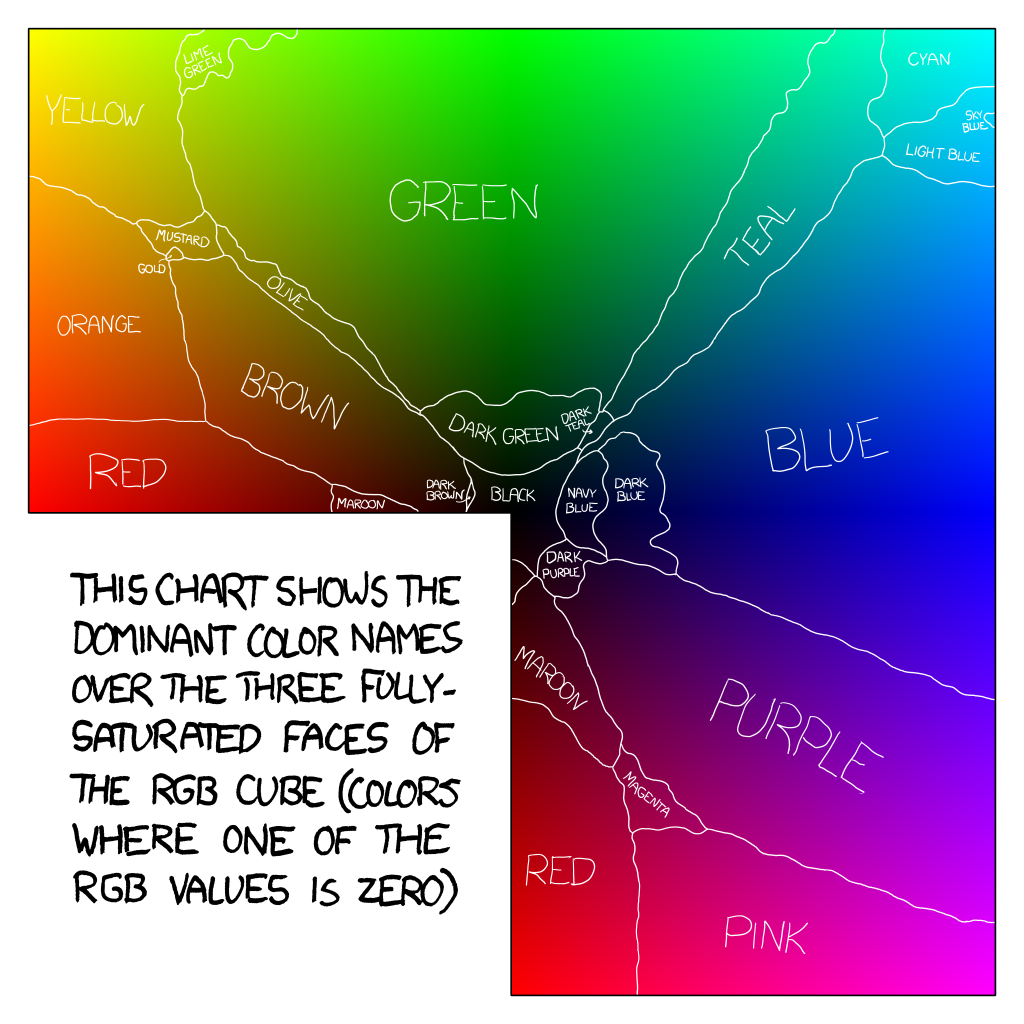
The data for this chart is here (3.6 MB text file with each RGB triplet named). Despite some requests, I’m not planning to make a poster of any of this, since it seems wrong to take advantage of all this volunteer effort for a profit; I just wanted to see what the results looked like. You’re welcome to print one up yourself (huge copy here), but keep in mind that print color spaces are different from monitor ones.
Basic Issues
Of course, there are basic issues with this color survey. People are primed by the colors they saw previously, which adds overall noise and some biases to the data (although it all seemed to even out in the end). Moreover, monitors vary; RGB is not an absolute color space. Fortunately, what I’m really interested in is what colors will look like on a typical monitors, so most of this data is across the sample of all non-colorblind users on all types of monitors (>90% LCD, roughly 6% CRT).
Color is a really fascinating topic, especially since we’re taught so many different and often contradictory ideas about rainbows, different primary colors, and frequencies of light. If you want to understand it better, you might try the neat introduction in Chapter 35 ofThe Feynman Lectures on Physics (Vol. 1), read Charles Poynton’s Color FAQ, or just peruse links from the Wikipedia article on color. For the purposes of this survey, we’re working inside the RGB space of the average monitor, so this data is useful for picking and naming screen colors. And really, if you’re reading this blog, odds are you probably—like me—spend more time looking at a monitor than at the outdoors anyway.
Miscellaneous
Lastly, here are some assorted things people came up with while labeling colors:

Thank you so much to relsqui for writing the survey frontend, and to everyone else who sacrificed their eyeballs for this project. If you have ideas and want to analyze these results further, I’ve posted the raw data as an SQLite dump here (84 MB .tar.gz file). It’s been anonymized, with IPs, URLs, and emails removed. I also have GeoIP information; if you’d like to do geocorrelation of some kind, I’ll be providing a version of the data with basic region-level lat/long information (limited to protect privacy) sometime in the next few days. Note: The ColorDB data is the main survey. The SatOnly data is the supplementary survey covering only the RGB faces in the map, and was presented on a half-black half-white background.)
And, of course, if you do anything fun with this data, I’d love to see the results—let me know at xkcd@xkcd.com.
 xkcd
xkcd 

Hah!
“Grey” for the win.
LikeLike
wow. I loved. LOVED this . thanks
LikeLike
The results have both “purpleish blue” (#6140ef) and “purplish blue” (#601ef9). Were these intentionally left distinct?
LikeLike
Olive and Olive Green. Love it.
Jesus Christ, what is with you and green? I was very tickled by that 🙂
In the Google illustration it says google said “Did you mean: FUSCHIA” not FUCHSIA. S before H according to Google.
LikeLike
Good job man. I love the analysis.
LikeLike
RED as the cute boy to my right’s hoodie! <3Ä:x
LikeLike
Nice post, grabbed some ideas of yours. Really like the color map 🙂
LikeLike
I will always remember teal, thank you Starcraft!
LikeLike
I am so glad that more people like grey instead of gray!
I have always preferred grey because it feels like a bluish-tinted grey, whereas gray feels like a brownish-tinted gray. As I prefer blue-greys to brown-grays, I therefore have always chosen to spell grey and grey, even though I am American, and not British. ^ ^
LikeLike
It’s probably been mentioned already, but frankly I can’t be arsed to read all 205 comments posted so far, but “Fuchsia” was named in honour of Leonhart Fuchs (1501 to 1566) who was one of the early European botanists. The plant was discovered by a French geezer (D. Charles Plumier) in the Dominican Republic a hundred and thirty years after Fuchs’ death.
LikeLike
If “[…]nicotine,” “veloci[…]cloaca,” and “[…]half hour[…]night[…]sky” are all from the same session, then they’re all mine.
I really actually do think they’re all mine, I just was too much of a dolt to record my entries at the time. So, in lieu of hard evidence confirming my claims, allow me to share a joke I made a few days ago.
(Caveat: I am Reptar.)
A carpenter, a cephalopod, and Immanuel Kant walk into a bar.
Quoth the cephalopod, “Spin is the only determinant separating particles of mass from particles of energy. Particles with half-integer spins are matter, and particles with whole integers are energy.”
So the carpenter orders a drink.
LikeLike
“Despite some requests, I’m not planning to make a poster of any of this, since it seems wrong to take advantage of all this volunteer effort for a profit; I just wanted to see what the results looked like.”
You could make a poster and donate the price to a charity (minus whatever it would cost to print, and possibly a small bit that would add up to cover time taken to prep it). People get a cool thing, a deserving cause of your choice gets money, you’re not profiting off of volunteers! Everyone wins! Except that the monitor-to-print conversion might be difficult. It’s just a thought.
LikeLike
Thank you for this, it is interesting to read the results!
LikeLike
This. Is. Amazing.
Thank you for being .. well, for being, frankly.
LikeLike
damn! I know I should have said something more spectacular in my results. The colours made my brain hurt, a bit. But it was fun.
Thank you for this, it was highly interesting. So is your comic in general.
And…
I hate hate hate statistics (failed it, got A+ in calculus), so thank you for slogging through all that to make comprehensible, highly readable information.
We owe you big time.
LikeLike
I wish I answered the survey. I would’ve probably written, “Boomer Puke Green.”
LikeLike
Nice results and awesome you made some of the data available
LikeLike
interesting read and awesome you posted the data
LikeLike
Wow, as a psychology student, and one who knows secretly he should have done maths after all, this is stupidly interesting. I’m gonna take those results of yours kind sir, and save myself some major sampling time next time i have to do something regarding cognition of vision.
Maybe i’ll even think of something fun to do with it all…
LikeLike
I wish I could stop mousing over comments hoping for tooltip popups.
LikeLike
Thanks again for an informative webpage.
LikeLike
did you track the localization of the people? For instance, I’m italian and I do the survey, but I don’t know all the names for different colors in english, so in many case I aproximate to the basic color, without further specifications.
cheers, Federica
ps. Fuchsia and fucsia are both good, all the others terms are wrong. Some people also wrote fuxia, though
LikeLike
You had me at “baige.”
LikeLike
Thank you for this. The members of my lab and I have often had the ‘men and women perceive color differently’ conversation. I laughed so hard when I got to the ‘I weep for my gender’ comment that I cried. Awesome!
LikeLike
@ XX Dude, Bently, and Jessica:
Do you honestly believe that the difference caused by the lack of consideration for the people you mention would cause a statistically meaningful difference in data? The presence of male-identified XXs and female-identified XYs obviously wasn’t enough to skew the Dusty Teal / Penis results away from what was (lamentably) expected. Also, the overall difference between the colours identified by those with Y chomosomes and those without was markedly *less* than expected, which would indicate that the potential difference from including or ignoring this data would be astronomically small.
Do you truly believe there is a data anomaly here, or are you just upset because you aren’t being recognized? In my experience with transgendered people (et al) it’s almost always the latter.
LikeLike
Glad to see you settled on a hillclimbing algorithm I was going to suggest a markove chain with possibly a touch of nested sampling when I was reading through and so the problems with your centre finding.
LikeLike
All that work, Randall, and you still can’t spell “Colour” 😉
LikeLike
As some have pointed out (most recently briang), this “study” is horrifically faulty in construction, implementation, and analysis. It’s about as useful and informative as watching a typical episode of [name-your-reality-tv-poison]. At best, it’s an amateurish diversion with an excess of shoddy infographics as so-called results.
Despite the implication in the survey’s introduction, no “purpose” is disclosed in this results post. That’s the most telling and important thing to consider; it saves one from a lengthy dissection of what’s so wrong with the whole shebang. Hence this _brief_ critique:
Was the author interested in documenting color perception or color naming? It’s a critical distinction which is completely muddled, to make an ironic observation.
If one is interested in perception, a better approach is something akin to the “color iq test” .
If one is interested in appellations, then an approach closer to the one presented here is reasonable, but requires a much more cogent execution. For instance, as one component, start with a large sample of both male and female graphic professionals, who are trained in color recognition and naming, then proceed from there.
If a lay perspective is desired, one must still address sociological and experiential phenomena: instead of asking questions about the monitor’s gamma, heat levels, and so forth (which I’m certain provided negligible usable data in this version—best, of course, to use a controlled lab), query subjects about how long and often they’ve read clothing catalogs, visited makeup counters, consulted the wall of paint samples at their local home store, and so forth. These seeming superficialities are probably more essential to the (presumed) aims even than the objective undeniability of color blindness.
As for addressing sex and gender, the inconsistency and ignorance is palpable. Either diligently encompass ALL aspects (physiological, chromosomal, psychological, and—as long as we’re giving lip service to transgenderism—current thinking on “brain sex”) or leave it alone.
In all, this survey and its results aren’t fit to wrap electronic fish. Sorry, Charlie.
LikeLike
If your color was a song:
http://www.ilike.com/artist/Ken+Nordine/album/Colors?src=onebox
LikeLike
Remember that there is also likely to be an effect in which guys think that in order to be manly, they should be incapable of distinguishing subtle color shades. It would not surprise me if some fraction of men could actually see the difference between two shades, but deliberately overgeneralize so as to conform to stereotype.
LikeLike
Wow, I had a BLAST taking this survey, and reading through this *gropes for word* essay, was fantastic. I wish I could repeat the experiment here at UConn, but I don’t think this has anything to do with Linguistics.
(by the way, we Linguists DO have it too easy, I demand more comics that make fun of ideas that are hued with some mixture of blue and yellow and feel anger at their slumber)
Also, The RGB square would make a fantastic poster-I for one wouldn’t mind buying it.
LikeLike
Forget about spelling, how many people can even pronounce fuchsia correctly? 😉 I’m afraid the answer would be the same as the number of people who can spell – zero! 😐
LikeLike
I notice my color ‘brain matter’ doesn’t appear anywhere. 😦
LikeLike
Hey!
Very nice survey. I like the answers you mentioned in the last pictures.
I have to agree, that you get crazy after 50 colors in a row. And I did about 80 till I understood, that I have to end the survey on my own. I just waited for an ending the last 40 colors, I guess. But the result really was worth it. 🙂
LikeLike
@pannonica I think you should have tried harder to understand the motivations behind the survey before offering your critique.
It’s fair to say it was not to test if a bunch of informed experts or laymen under controlled conditions can correctly label colours and if their is any difference in their competence at doing so based on their number of chromosomes. That sounds like an entirely different study.
LikeLike
holy cow, that’s a thorough analysis!
LikeLike
I believe that the reason no one can spell fuchsia is that it was spelled incorrectly in the Microsoft dictionary for a long time. I remember noticing this sometime in the early 1990s, and it was true for many years after that.
While this may not have affected the likelihood of a member of the general population spelling it correctly, it probably does impact the subset who would have taken this survey.
LikeLike
Pannonica, despite your obvious trolling, I feel compelled to draw your attention to the following for a reasonable explanation of irony and the American wit.
LikeLike
LikeLike
Munroe, you have the sexiest brain in the known Universe, second only to that of my partner.
LikeLike
……” a reminder that grandma needs to be cut off after the third glass.” HAHAHAHAA!!!!
BTW, I am one of the chosen few who can spell fuchsia…. 🙂
LikeLike
Helena: First, I’m not interested in trolling; I expressed a relatively concise response to something that people seem to be imbuing with far too much credibility and relevance. Disingenuously linking to Alanis Morrisette’s unintentionally meta-ironic song seems more troll-like behavior to me. And as she’s Canadian, I fail to see what that has to say about “American” wit.
Iain: I tried to glean the motivations by reading the survey’s introduction, in which the author explains that he was keeping them cloaked until after the results were in. The results posting contains precious little explaining whatever purpose was envisioned. I did my best to take the whole thing reasonably seriously; perhaps that was my mistake.
LikeLike
Can we please have the RGB triplet for Baige?
LikeLike
any difference in their competence at doing so based on their number of chromosomes – but that was one of the stated questions, both in the survey introductory and in the opening of the article.
And there should be some discussion about how much usable colour space data was collected, whether it made a difference, and how differences in colour space were dealt with. Why was there no colour calibration screen at the start of the survey?
Then there is the problem of colour level perception. It is clear that one goal was to figure out what colour differences people would report. But are these voluntary or not? Do people answer ‘green’ to so many colours because they have trouble telling them apart or because they simply don’t know more specific names? And what if for example lack of imagination plays a part? It is well known that the brain can be very unidirectional in cases and it’s possible that the subjects actually knew many more colour names than they actually report.
As for the final ‘info’-graphics, they would have been useless without some indication of how many data points the boundaries are based on, even if the data weren’t so flawed.
Now, I actually think this is a cool thing to study, it’s just that before you conducted this, you should have had a chat with people who know stuff about colour and how computers handle them, and people who know how to conduct surveys. As is, not even the data is useful, let alone the results.
LikeLike
Pannonica: Did it occur to you that some people just like playing around with statistics and numbers and charts with whatever random data they can get their hands on? Nobody cares how legitimate this survey was, it was fun, and it’s interesting to have different types of data presented in different ways.
See also:
http://www.xkcd.com/715/
http://www.xkcd.com/696/
http://www.xkcd.com/681/
http://www.xkcd.com/657/
LikeLike
There’s been a lot of studies similar to yours on the cultural component of color. You might want to check out Berlin and Kay’s “Basic Color Terms: Their Universality and Evolution” for a study that was quite interesting, if a bit old.
LikeLike
Iain: Also, I never said anything about professionals (or anyone else for that matter) _correctly_ naming anything. It’s a matter of acumen.
I agree with Anonymous Coward’s interpretation. It’s a fascinating subject which is completely disserved by this romp, moreso for the credence people are attributing to it.
LikeLike