Who in the rainbow can draw the line where the violet tint ends and the orange tint begins? Distinctly we see the difference of the colors, but where exactly does the one first blendingly enter into the other? So with sanity and insanity.
—Herman Melville, Billy Budd
Orange, red? I don’t know what to believe anymore!
—Anonymous, Color Survey
I WILL EAT YOUR HEART WITH A FUCKING SPOON IF YOU AKS ANY MORE QUESTIONS ABOUT COLORS
—Anonymous, Color Survey
Thank you so much for all the help on the color survey. Over five million colors were named across 222,500 user sessions. If you never got around to taking it, it’s too late to contribute any data, but if you want you can see how it worked and take it for fun here.
First, a few basic discoveries:
- If you ask people to name colors long enough, they go totally crazy.
- “Puke” and “vomit” are totally real colors.
- Colorblind people are more likely than non-colorblind people to type “fuck this” (or some variant) and quit in frustration.
- Indigo was totally just added to the rainbow so it would have 7 colors and make that “ROY G. BIV” acronym work, just like you always suspected. It should really be ROY GBP, with maybe a C or T thrown in there between G and B depending on how the spectrum was converted to RGB.
- A couple dozen people embedded SQL ‘drop table’ statements in the color names. Nice try, kids.
- Nobody can spell “fuchsia”.
Overall, the results were really cool and a lot of fun to analyze. There are some basic limitations of this survey, which are discussed toward the bottom of this post. But the sheer amount of data here is cool.
Sex
By a strange coincidence, the same night I first made the color survey public, the webcomic Doghouse Diaries put up this comic (which I altered slightly to fit in this blog, click for original):

It was funny, but I realized I could test whether it was accurate (as far as chromosomal sex goes, anyway, which we asked about because it’s tied to colorblindness) [Note: For more on this distinction, see my follow-up post]. After the survey closed, I generated a version of the Doghouse Diaries comic with actual data, using the most frequent color name for the handful of colors in the survey closest to the ones in the comic:

Basically, women were slightly more liberal with the modifiers, but otherwise they generally agreed (and some of the differences may be sampling noise). The results were similar across the survey—men and women tended on average to call colors the same names.
So I was feeling pretty good about equality. Then I decided to calculate the ‘most masculine’ and ‘most feminine’ colors. I was looking for the color names most disproportionately popular among each group; that is, the names that the most women came up with compared to the fewest men (or vice versa).
Here are the color names most disproportionately popular among women:
- Dusty Teal
- Blush Pink
- Dusty Lavender
- Butter Yellow
- Dusky Rose
Okay, pretty flowery, certainly. Kind of an incense-bomb-set-off-in-a-Bed-Bath-&-Beyond vibe. Well, let’s take a look at the other list.
Here are the color names most disproportionately popular among men:
- Penis
- Gay
- WTF
- Dunno
- Baige
I … that’s not my typo in #5—the only actual color in the list really is a misspelling of “beige”. And keep in mind, this is based on the number of unique people who answered the color, not the number of times they typed it. This isn’t just the effect of a couple spammers. In fact, this is after the spamfilter.
I weep for my gender. But, on to:
RGB Values
Here are RGB values for the first 48 out of about a thousand colors whose RGB values (across the average monitor, shown on a white background) I was able to pin down with a fairly high degree of precision:

The full table of 954 colors is here, also available as a text file here (I have no opinion about whether it should be used to build a new X11 rgb.txt except that seems like the transition would be a huge headache.)
The RGB value for a name is based on the location in the RGB color space where there was the highest frequency of responses choosing that name. This was tricky to calculate. I tried simple geometric means (conceptually flawed), a brute force survey of all potential center points (too slow), and fitting kernel density functions (math is hard). In the end, I used the average of a bunch of runs of a stochastic hillclimbing algorithm. For mostly boring notes on my data handling for this list, see the comments at the bottom of the xkcd.com/color/rgb/ page.
Spelling and Spam
Spelling was an issue for a lot of users:

Now, you may notice that the correct spelling is missing. This is because I can’t spell it either, and when running the analysis, used Google’s suggestion feature as a spellchecker:

A friend pointed out that to spell it right, you can think of it as “fuck-sia” (“fuch-sia”).
Misspellings aside, a lot of people spammed the database, but there were some decent filters in place. I dropped out people who gave too many answers which weren’t colors used by many other people. I also looked at the variation in hue; if people gave the same answer repeatedly for colors of wildly varying hue, I threw out all their results. This mainly caught people who typed the same thing over and over. Some were obviously using scripts; based on the filter’s certainty, the #1 spammer in the database was someone who named 2,400 colors—all with the same racial slur.
Map
Here’s a map of color boundaries for a particular part of the RGB cube. The data here comes from a portion of the survey (1.5 million results) which sampled only this region and showed the colors against both black and white backgrounds.
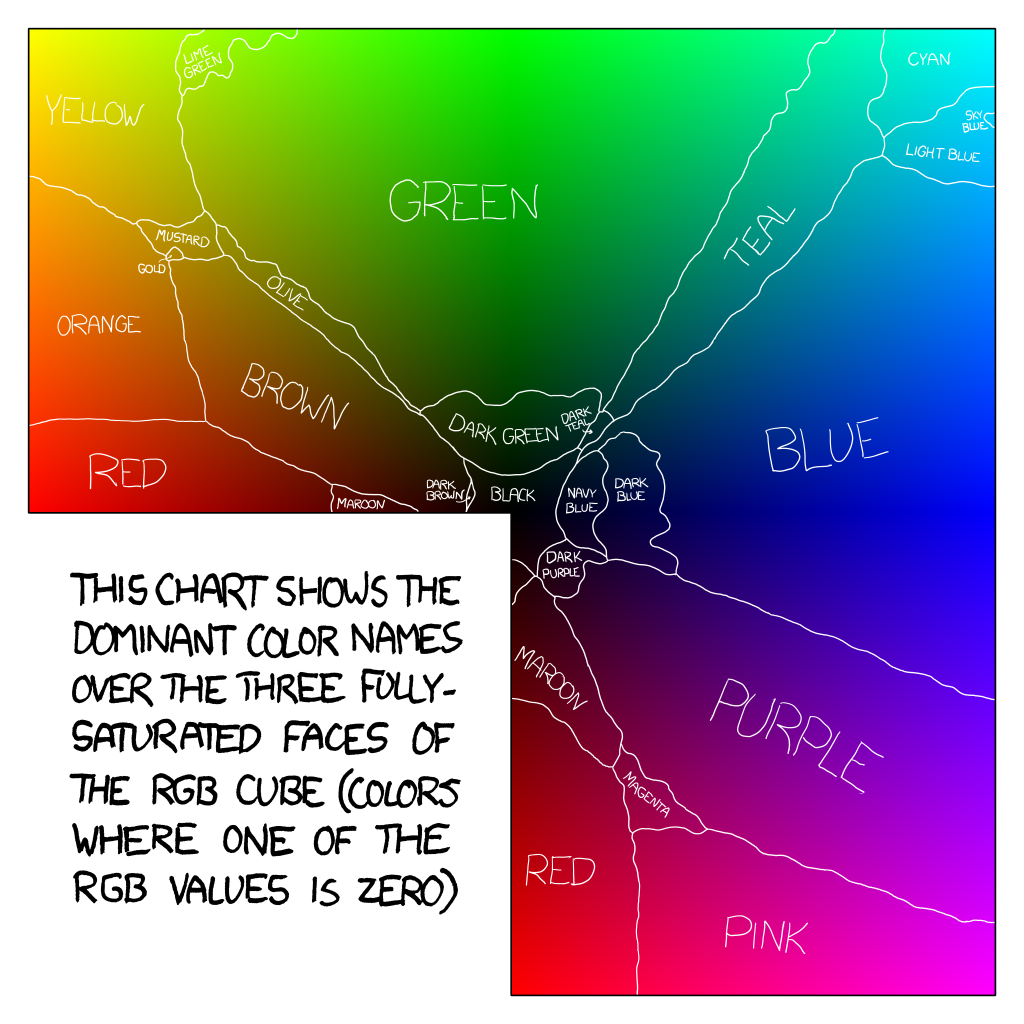
The data for this chart is here (3.6 MB text file with each RGB triplet named). Despite some requests, I’m not planning to make a poster of any of this, since it seems wrong to take advantage of all this volunteer effort for a profit; I just wanted to see what the results looked like. You’re welcome to print one up yourself (huge copy here), but keep in mind that print color spaces are different from monitor ones.
Basic Issues
Of course, there are basic issues with this color survey. People are primed by the colors they saw previously, which adds overall noise and some biases to the data (although it all seemed to even out in the end). Moreover, monitors vary; RGB is not an absolute color space. Fortunately, what I’m really interested in is what colors will look like on a typical monitors, so most of this data is across the sample of all non-colorblind users on all types of monitors (>90% LCD, roughly 6% CRT).
Color is a really fascinating topic, especially since we’re taught so many different and often contradictory ideas about rainbows, different primary colors, and frequencies of light. If you want to understand it better, you might try the neat introduction in Chapter 35 ofThe Feynman Lectures on Physics (Vol. 1), read Charles Poynton’s Color FAQ, or just peruse links from the Wikipedia article on color. For the purposes of this survey, we’re working inside the RGB space of the average monitor, so this data is useful for picking and naming screen colors. And really, if you’re reading this blog, odds are you probably—like me—spend more time looking at a monitor than at the outdoors anyway.
Miscellaneous
Lastly, here are some assorted things people came up with while labeling colors:

Thank you so much to relsqui for writing the survey frontend, and to everyone else who sacrificed their eyeballs for this project. If you have ideas and want to analyze these results further, I’ve posted the raw data as an SQLite dump here (84 MB .tar.gz file). It’s been anonymized, with IPs, URLs, and emails removed. I also have GeoIP information; if you’d like to do geocorrelation of some kind, I’ll be providing a version of the data with basic region-level lat/long information (limited to protect privacy) sometime in the next few days. Note: The ColorDB data is the main survey. The SatOnly data is the supplementary survey covering only the RGB faces in the map, and was presented on a half-black half-white background.)
And, of course, if you do anything fun with this data, I’d love to see the results—let me know at xkcd@xkcd.com.
 xkcd
xkcd 

Yeah, Red is the color in the world!
LikeLike
What does this
LikeLike
Its funny how men and women choose similar colors. Thanks for the info
LikeLike
I’ve had a few salmon shirts in my day.
LikeLike
Your website is very useful
LikeLike
Thanks for the blog loaded with so many information.
LikeLike
😛 Link is broken, http://aram.xkcd.com/color/
It gives me a 404. But nice data!
LikeLike
Gosh, I just laughed myself silly over the “Miscellaneous”-part! Had to bite my knuckles not to wake up my mom. I really sympathise with people; it feel like I’ve forgotten how colours look like…
LikeLike
This is hilarious! Sounds like a fun survey! Kinda bummed I couldn’t find it. But I loved reading about it! 😀
LikeLike
I like Blueish and green . Colors are good when ur on LSD
LikeLike
I love colors and this is great!! As well of course puke and vomit are colors love it!!!! Next time I go to the store im going to ask do you have that shirt in vomit please!
LikeLike
polo outlet So polo charm a portly number of people. Mens polo shirts can be old for many occasions and events such as golf or entirely dressing for a party. polo shirts in compensation men may provide gladden, while being haphazard sufficiency looking for the job. Every the human race should have at least undivided polo.
LikeLike
It’s “Fuschia” according to google, wiki and dictionary.com
LikeLike
I like it!
LikeLike
I pleasantly remember losing half my sanity back when the data was being recorded
The same colour came fifteen times in a row, and I starte to worry if they were actually different and Mr Munroe had sent me colourblind
Good times
LikeLike
polo outlet So polo lure a muscular number of people. Mens polo shirts can be worn looking for numerous occasions and events such as golf or entirely dressing quest of a party. polo shirts in compensation men may victual gladden, while being happy-go-lucky tolerably seeking the job. Every human beings should hold at least identical polo.
LikeLike
Its funny how men and women choose similar colors. Thanks for the info
LikeLike
It’s “Fuschia” according to google, wiki and dictionary.com
LikeLike
It’s very funny!
It seems that when people have the choice they are unable to decide!
LikeLike
The same colour came fifteen times in a row, and I starte to worry if they were actually different and Mr Munroe had sent me colourblind
Good times Thank.
LikeLike
The differences between how the sexes see the colors are hilarious. I see this all the time with my girlfriend.
LikeLike
Really good, thanks for sharing!
LikeLike
And the point of all this is…….?
(no I’m not color blind)
LikeLike
And the point of all this is….?
(no, I’m not colorblind)
LikeLike
And the point of all this is……?
(and no, I’m not colorblind)
LikeLike
Good post, like it, thanks.
LikeLike
Wonderful insight. It is interesting the differences a color makes.
LikeLike
aha that is a wonderful colors, thanks.
LikeLike
Do another surveeeeyyyy…
LikeLike
Color surveys are really amusing. People only knows common colors like for example, they consider lime green as simple green.
LikeLike
Now I want to see the straight vs. gay version of this. 🙂
LikeLike
I remember reading this when it was first published, and the recent blog post pointing out a reference to the other comic. Use the dataset to create a website to help people find a color they want based on the name – sell it to paint companies as a tool for finding paint colors. Probably need to do some kind of statistical match, and encourage people to be highly descriptive. Make it a learning system too – when people click on the ‘yah, that’s the color I meant’ button finally, add their name for it to the data set. Maybe if I get bored later on, I will download the set and play around with it.
LikeLike
Really nice article. Thanks a lot!
Regards,
XBOX 360.
LikeLike
What a hoot. You are the admired leader in a field (grass green) of geek info enthusiasts. As an artist, I appreciate your care to the topic: and I know how to spell fuschia. In fact, my dad used to playfully name ‘mauve, puce and fuschia’ when asked his favorite color, so the gender differences are certainly not universal.
One more thing, looking at the green/blue versus other colors’ names, genderwise, I am reminded that borderline blue/green colorblindness is much more common in men.
And that linguistically, you can add data to this piece: in Japanese, blue and green are called by one color name and distinguished from there. In protolanguages, red and black are the first colors to be named, then white.
Color. Golly.
And of course polo shirts. Have you checked your comments lately?
Thanks again-
LikeLike
weeping for my gender too. though its partly because of laughter. this is hilarious!
LikeLike
While I didn’t use your data to do this, it’s in a similar vein, and I thought it might make you smile:
http://madbodger.livejournal.com/119610.html
LikeLike
regarding the correct spelling of fuchsia. Looking at dictionary.com, you get a second chance at a mnemonic if you can remember the plant California Fuck-sia…
http://dictionary.reference.com/browse/fuchsia
LikeLike
Baige
LikeLike
This is a very interesting site. I have written a blog about teton backpack as well to visit me at teton backpack
LikeLike
Ken Nordine did a spoken-word jazz series on a bunch of different colours. I recommend listening to a few. They sort of remind me of Dr. Seuss rhymes.
LikeLike