Who in the rainbow can draw the line where the violet tint ends and the orange tint begins? Distinctly we see the difference of the colors, but where exactly does the one first blendingly enter into the other? So with sanity and insanity.
—Herman Melville, Billy Budd
Orange, red? I don’t know what to believe anymore!
—Anonymous, Color Survey
I WILL EAT YOUR HEART WITH A FUCKING SPOON IF YOU AKS ANY MORE QUESTIONS ABOUT COLORS
—Anonymous, Color Survey
Thank you so much for all the help on the color survey. Over five million colors were named across 222,500 user sessions. If you never got around to taking it, it’s too late to contribute any data, but if you want you can see how it worked and take it for fun here.
First, a few basic discoveries:
- If you ask people to name colors long enough, they go totally crazy.
- “Puke” and “vomit” are totally real colors.
- Colorblind people are more likely than non-colorblind people to type “fuck this” (or some variant) and quit in frustration.
- Indigo was totally just added to the rainbow so it would have 7 colors and make that “ROY G. BIV” acronym work, just like you always suspected. It should really be ROY GBP, with maybe a C or T thrown in there between G and B depending on how the spectrum was converted to RGB.
- A couple dozen people embedded SQL ‘drop table’ statements in the color names. Nice try, kids.
- Nobody can spell “fuchsia”.
Overall, the results were really cool and a lot of fun to analyze. There are some basic limitations of this survey, which are discussed toward the bottom of this post. But the sheer amount of data here is cool.
Sex
By a strange coincidence, the same night I first made the color survey public, the webcomic Doghouse Diaries put up this comic (which I altered slightly to fit in this blog, click for original):

It was funny, but I realized I could test whether it was accurate (as far as chromosomal sex goes, anyway, which we asked about because it’s tied to colorblindness) [Note: For more on this distinction, see my follow-up post]. After the survey closed, I generated a version of the Doghouse Diaries comic with actual data, using the most frequent color name for the handful of colors in the survey closest to the ones in the comic:

Basically, women were slightly more liberal with the modifiers, but otherwise they generally agreed (and some of the differences may be sampling noise). The results were similar across the survey—men and women tended on average to call colors the same names.
So I was feeling pretty good about equality. Then I decided to calculate the ‘most masculine’ and ‘most feminine’ colors. I was looking for the color names most disproportionately popular among each group; that is, the names that the most women came up with compared to the fewest men (or vice versa).
Here are the color names most disproportionately popular among women:
- Dusty Teal
- Blush Pink
- Dusty Lavender
- Butter Yellow
- Dusky Rose
Okay, pretty flowery, certainly. Kind of an incense-bomb-set-off-in-a-Bed-Bath-&-Beyond vibe. Well, let’s take a look at the other list.
Here are the color names most disproportionately popular among men:
- Penis
- Gay
- WTF
- Dunno
- Baige
I … that’s not my typo in #5—the only actual color in the list really is a misspelling of “beige”. And keep in mind, this is based on the number of unique people who answered the color, not the number of times they typed it. This isn’t just the effect of a couple spammers. In fact, this is after the spamfilter.
I weep for my gender. But, on to:
RGB Values
Here are RGB values for the first 48 out of about a thousand colors whose RGB values (across the average monitor, shown on a white background) I was able to pin down with a fairly high degree of precision:

The full table of 954 colors is here, also available as a text file here (I have no opinion about whether it should be used to build a new X11 rgb.txt except that seems like the transition would be a huge headache.)
The RGB value for a name is based on the location in the RGB color space where there was the highest frequency of responses choosing that name. This was tricky to calculate. I tried simple geometric means (conceptually flawed), a brute force survey of all potential center points (too slow), and fitting kernel density functions (math is hard). In the end, I used the average of a bunch of runs of a stochastic hillclimbing algorithm. For mostly boring notes on my data handling for this list, see the comments at the bottom of the xkcd.com/color/rgb/ page.
Spelling and Spam
Spelling was an issue for a lot of users:

Now, you may notice that the correct spelling is missing. This is because I can’t spell it either, and when running the analysis, used Google’s suggestion feature as a spellchecker:

A friend pointed out that to spell it right, you can think of it as “fuck-sia” (“fuch-sia”).
Misspellings aside, a lot of people spammed the database, but there were some decent filters in place. I dropped out people who gave too many answers which weren’t colors used by many other people. I also looked at the variation in hue; if people gave the same answer repeatedly for colors of wildly varying hue, I threw out all their results. This mainly caught people who typed the same thing over and over. Some were obviously using scripts; based on the filter’s certainty, the #1 spammer in the database was someone who named 2,400 colors—all with the same racial slur.
Map
Here’s a map of color boundaries for a particular part of the RGB cube. The data here comes from a portion of the survey (1.5 million results) which sampled only this region and showed the colors against both black and white backgrounds.
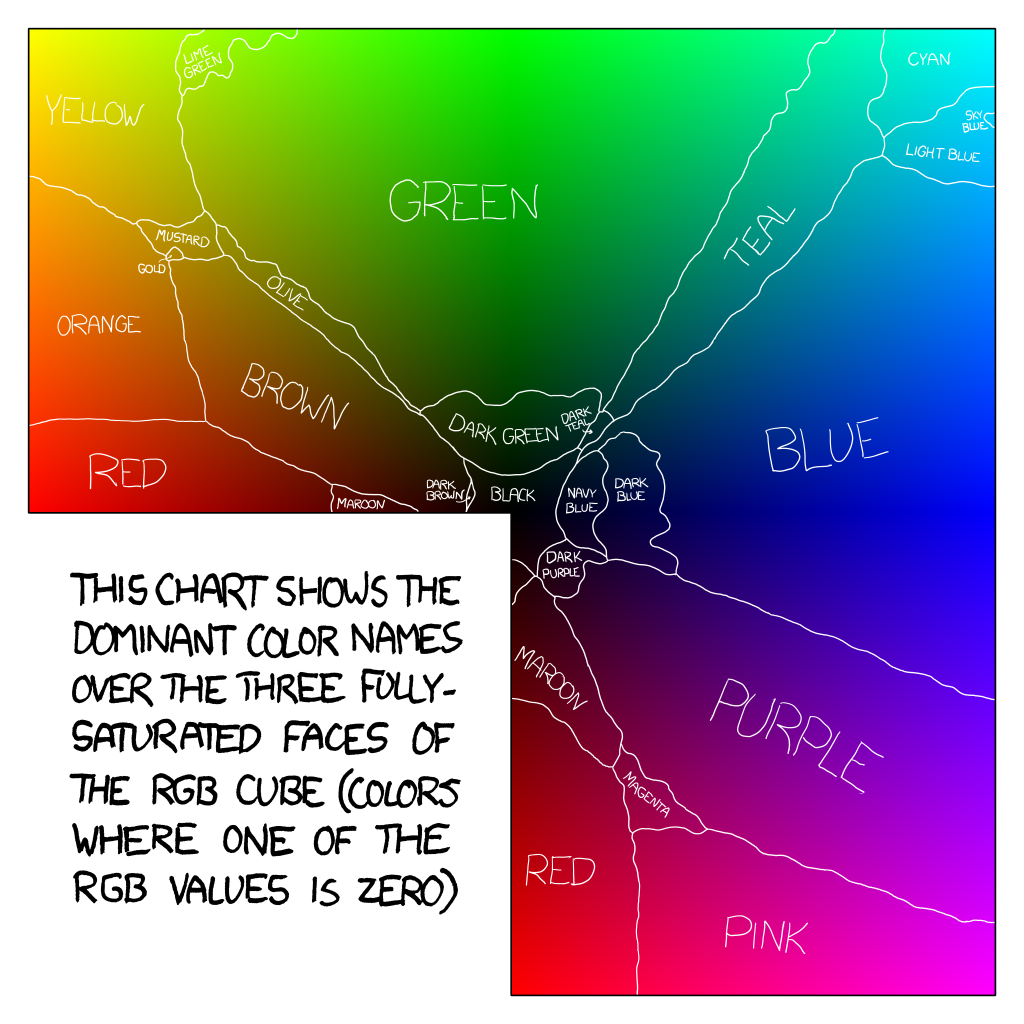
The data for this chart is here (3.6 MB text file with each RGB triplet named). Despite some requests, I’m not planning to make a poster of any of this, since it seems wrong to take advantage of all this volunteer effort for a profit; I just wanted to see what the results looked like. You’re welcome to print one up yourself (huge copy here), but keep in mind that print color spaces are different from monitor ones.
Basic Issues
Of course, there are basic issues with this color survey. People are primed by the colors they saw previously, which adds overall noise and some biases to the data (although it all seemed to even out in the end). Moreover, monitors vary; RGB is not an absolute color space. Fortunately, what I’m really interested in is what colors will look like on a typical monitors, so most of this data is across the sample of all non-colorblind users on all types of monitors (>90% LCD, roughly 6% CRT).
Color is a really fascinating topic, especially since we’re taught so many different and often contradictory ideas about rainbows, different primary colors, and frequencies of light. If you want to understand it better, you might try the neat introduction in Chapter 35 ofThe Feynman Lectures on Physics (Vol. 1), read Charles Poynton’s Color FAQ, or just peruse links from the Wikipedia article on color. For the purposes of this survey, we’re working inside the RGB space of the average monitor, so this data is useful for picking and naming screen colors. And really, if you’re reading this blog, odds are you probably—like me—spend more time looking at a monitor than at the outdoors anyway.
Miscellaneous
Lastly, here are some assorted things people came up with while labeling colors:

Thank you so much to relsqui for writing the survey frontend, and to everyone else who sacrificed their eyeballs for this project. If you have ideas and want to analyze these results further, I’ve posted the raw data as an SQLite dump here (84 MB .tar.gz file). It’s been anonymized, with IPs, URLs, and emails removed. I also have GeoIP information; if you’d like to do geocorrelation of some kind, I’ll be providing a version of the data with basic region-level lat/long information (limited to protect privacy) sometime in the next few days. Note: The ColorDB data is the main survey. The SatOnly data is the supplementary survey covering only the RGB faces in the map, and was presented on a half-black half-white background.)
And, of course, if you do anything fun with this data, I’d love to see the results—let me know at xkcd@xkcd.com.
 xkcd
xkcd 

Awesome … I did not take the test nor for my sanity do I wish to. But reading all these comments made me smile.
LikeLike
This is the FUNNIEST thing I have read in days! I cracked up so much! I am so glad I found this. I am the best color-namer ever. It’s too bad I couldn’t be a part of this project…
LikeLike
This is great. Besides some relevant stats on color it was funny just to see some funny survey comments.
LikeLike
Interesting one! It’s funny post. I like this one.
LikeLike
Wow. Thank you for posting all those results. I had wondered about it, having participated several times at varying hours of the day, and in different states of mind.
Very funny. Especially the bit about that ridiculous name for a shade of pink. As I recall, I had a fair amount of difficulty with that one as well, and I come from a long line of freakishly good spellers.
LikeLike
cool,thanks for the article
LikeLike
So, a number of my comments are in those outtakes, if you will. I distinctly remember typing “dull as all hell” one and the “skewing” comment. I am colorblind, so that’s where I thought the skew was coming from. Some of the others I only suspect; it’s been a while since I’ve answered.
I meant to check the results, but I forgot to. Glad to see that I may have caused chaos.
All the best.
LikeLike
I shouldn’t have tried to read this while eating. Oh my. Very funny (and interesting).
LikeLike
Useless comment, but just to say that I really like how you used ‘women’ and ‘men’ instead of ‘female’ and ‘male.’
Gender awareness for the win
LikeLike
Oh my God, I am laughing like a complete idiot here in my bedroom at one o’clock in the night, reading the SQL dump…
‘you”re trying to confuse me, aren”t you?’
‘you”re pregnant blue’
‘young velociraptor’
‘your mom covered in peanut butter’
‘your use of the subjunctive seems to imply that i am not, in fact, going to call this color anything. surprisingly, your assumption is correct.’
‘yup i”m pretty much a fangirl. and this color right here is pretty much straight gothic emo slasher punk’
‘zombie smurf’
…I just can’t wait for the next survey! xD
LikeLike
FUNNY AND INTERESTING
LikeLike
9ffeb0 — mint?
“Mint ice cream,” my wife says.
Seriously? Ice cream purveyors don’t make their mint ice cream look like actual mint, and because no one grows mint in their back yards, suddenly this pastel green color becomes “mint” which looks nothing like real mint?
LikeLike
lol at the miscellaneous section, i would be dying if i was going thru the results, great idea for a survey though.
LikeLike
haha, I love it!
LikeLike
Wow. I remember taking this survey and taking it super seriously at first but after 40 colors or so I started putting in fun answers like the ones at the bottom. Velociraptor Cloaca beats any of the ones I put in though.
LikeLike
I’m raging all over the place. Did nobody said “An hyperintelligent shade of the color blue” as an answer to some bluish color?
LikeLike
An interesting tidbit of information for you. Women may name colors simply because, biologically speaking, we do see the variation better… or at least that’s what some studies are suggesting. Has to do with the gene for seeing red being located on the x chromosome and as women have two they typically have a broader range of vision when it comes to the color spectrum.
The study I came across theorized it was due to the fact that when we were a hunter-gatherer culture, women who were able to distinguish the differences between fruit and berries that were or were not poisonous (and so had a better vision spectrum) had a higher likelihood of passing on that ability to their offspring (mainly because they weren’t poisoning themselves and all… XD ).
Anyway. Love the results! The survey was a lot of fun.
LikeLike
That is the article on color I have ever seen.
Please, somebody, replace wikipedia’s entry on “color” by this one
LikeLike
I remember taking this! I went insane and pucnhed everybody who asked me what my favorite color was for a few weeks after that…
LikeLike
Someone may already have said this, but I’m too lazy to read all 728 comments to find out: the color fuchsia is named after the flower, and the flower is named (according to Wikipedia, which is right about as often as most encyclopedias) after a German botanist named Fuchs. That’s how I remember how to spell it, now you can too! And without resorting to profanity.
I think the results of this study would be of most interest to the Crayola company.
LikeLike
P.S.: Apparently Lands’ End can’t spell it either, because they’re referring to a color that is clearly fuchsia as “teaberry.” (They also refer to a particular shade of medium blue as “lupine,” which I always thought meant “wolflike.”)
LikeLike
“Women may name colors simply because, biologically speaking, we do see the variation better… or at least that’s what some studies are suggesting.”
Causality problem. Some studies indicate that people may “see the variation better” because they have different words to describe them, not vice versa. If men cared to learn more color names and their associated hues, it seems likely that (outside of color blindness) they would likely perceive similar ranges as women. However, being interested in naming nuanced colors is seen as neither manly nor geeky.
LikeLike
Never saw it coming… don’t know what else I was expecting… when I scrolled down to reveal the top 5 most masculine color I almost pee’ed my pants. Never laughed that much with the sole company of my computer.
LikeLike
#42255D is an interesting color for the cloaca of velociraptors. I have shared this knowledge will all of my raptor-inclined friends.
We’ll all have a giggle at that one.
I’d have called it “royal purple.”
LikeLike
bwahahaaaaaaaaaaaha to dandruff wafting into gaping jaw,the wine stain,nicotine wallpaper ,and velociraptor cloaca!!!!!!!!!!!!!!!!!!!!!!!!!!!!!!!!!!!!!!!!!!!!!!!!!!!!!!!!!!!!!!!!!!!!!!!!!!!!!!!!!!!!!!!!!!!!!!!!!!!!!!!!!!!!!
LikeLike
LOL. “Unsure of whether it’s a boy or a girl” color.
LikeLike
Any idea if and where the GeoIP data has been published?
LikeLike
You seriously need to get laid.
As do I, for actually reading this and thinking how fascinating and entertaining it was.
…you doing anything saturday?
LikeLike
Hi, you’re possibly already aware of this, but just in case I’ll post it anyway;
http://www.apa.org/monitor/feb05/hues.aspx
Basically, peoples’ perception of colour and ability to name different shades of the same colour depends largely on whether there is a word for it in their language that they are aware of. So girls do on the whole have more words for different shades because we get spammed with them on different products – hot pink nailpolish, cherry red lipstick, and so on and so forth, and we tend to then associate that shade with that name.
LikeLike
Ha, Ha, I’m a little freaked out as I just painted our nursery for our new baby a light green. I’m off down B&Q with this colour chart and see what happens next.
LikeLike
Oh it very good
LikeLike
Oh god. I’m crying from laughing so hard. My stomach hurts. I love you.
LikeLike
It seems to me that salmon and teal are only in the color vocabulary because people have experienced them as websafe colors (web/graphic design) or through Microsoft products. We should all get out more!
Congratulations on a fantastic project, and get well soon to all.
P.S. My wife says penis is a real color and it’s beautiful (what a babe!)
LikeLike
Very interesting! What you have done using the computer monitor is very similar to we have been doing using the computer speakers.
Starting in 2007, we have made a map of the various accents of English
http://www.phys.unsw.edu.au/swe
Strictly, ours has four dimensions, but two of them are only sampled at two points, so most of our detail, like yours, is in 2D. So there are strong analogies.
LikeLike
There’s a lot of complaining about how many of them are green and, when I look back on doing the questionnaire, I remember being vaguely annoyed by how many of them *were* green. When you look at this chart, it becomes apparent why – we don’t seem to subdivide that part of the RGB cube up to the same degree. Blue is a fairly solid block, but not as big and red is comparatively very small. I wonder why.
LikeLike
Oh! it good idea
LikeLike
How i do it .i need to check my site
LikeLike