Who in the rainbow can draw the line where the violet tint ends and the orange tint begins? Distinctly we see the difference of the colors, but where exactly does the one first blendingly enter into the other? So with sanity and insanity.
—Herman Melville, Billy Budd
Orange, red? I don’t know what to believe anymore!
—Anonymous, Color Survey
I WILL EAT YOUR HEART WITH A FUCKING SPOON IF YOU AKS ANY MORE QUESTIONS ABOUT COLORS
—Anonymous, Color Survey
Thank you so much for all the help on the color survey. Over five million colors were named across 222,500 user sessions. If you never got around to taking it, it’s too late to contribute any data, but if you want you can see how it worked and take it for fun here.
First, a few basic discoveries:
- If you ask people to name colors long enough, they go totally crazy.
- “Puke” and “vomit” are totally real colors.
- Colorblind people are more likely than non-colorblind people to type “fuck this” (or some variant) and quit in frustration.
- Indigo was totally just added to the rainbow so it would have 7 colors and make that “ROY G. BIV” acronym work, just like you always suspected. It should really be ROY GBP, with maybe a C or T thrown in there between G and B depending on how the spectrum was converted to RGB.
- A couple dozen people embedded SQL ‘drop table’ statements in the color names. Nice try, kids.
- Nobody can spell “fuchsia”.
Overall, the results were really cool and a lot of fun to analyze. There are some basic limitations of this survey, which are discussed toward the bottom of this post. But the sheer amount of data here is cool.
Sex
By a strange coincidence, the same night I first made the color survey public, the webcomic Doghouse Diaries put up this comic (which I altered slightly to fit in this blog, click for original):

It was funny, but I realized I could test whether it was accurate (as far as chromosomal sex goes, anyway, which we asked about because it’s tied to colorblindness) [Note: For more on this distinction, see my follow-up post]. After the survey closed, I generated a version of the Doghouse Diaries comic with actual data, using the most frequent color name for the handful of colors in the survey closest to the ones in the comic:

Basically, women were slightly more liberal with the modifiers, but otherwise they generally agreed (and some of the differences may be sampling noise). The results were similar across the survey—men and women tended on average to call colors the same names.
So I was feeling pretty good about equality. Then I decided to calculate the ‘most masculine’ and ‘most feminine’ colors. I was looking for the color names most disproportionately popular among each group; that is, the names that the most women came up with compared to the fewest men (or vice versa).
Here are the color names most disproportionately popular among women:
- Dusty Teal
- Blush Pink
- Dusty Lavender
- Butter Yellow
- Dusky Rose
Okay, pretty flowery, certainly. Kind of an incense-bomb-set-off-in-a-Bed-Bath-&-Beyond vibe. Well, let’s take a look at the other list.
Here are the color names most disproportionately popular among men:
- Penis
- Gay
- WTF
- Dunno
- Baige
I … that’s not my typo in #5—the only actual color in the list really is a misspelling of “beige”. And keep in mind, this is based on the number of unique people who answered the color, not the number of times they typed it. This isn’t just the effect of a couple spammers. In fact, this is after the spamfilter.
I weep for my gender. But, on to:
RGB Values
Here are RGB values for the first 48 out of about a thousand colors whose RGB values (across the average monitor, shown on a white background) I was able to pin down with a fairly high degree of precision:

The full table of 954 colors is here, also available as a text file here (I have no opinion about whether it should be used to build a new X11 rgb.txt except that seems like the transition would be a huge headache.)
The RGB value for a name is based on the location in the RGB color space where there was the highest frequency of responses choosing that name. This was tricky to calculate. I tried simple geometric means (conceptually flawed), a brute force survey of all potential center points (too slow), and fitting kernel density functions (math is hard). In the end, I used the average of a bunch of runs of a stochastic hillclimbing algorithm. For mostly boring notes on my data handling for this list, see the comments at the bottom of the xkcd.com/color/rgb/ page.
Spelling and Spam
Spelling was an issue for a lot of users:

Now, you may notice that the correct spelling is missing. This is because I can’t spell it either, and when running the analysis, used Google’s suggestion feature as a spellchecker:

A friend pointed out that to spell it right, you can think of it as “fuck-sia” (“fuch-sia”).
Misspellings aside, a lot of people spammed the database, but there were some decent filters in place. I dropped out people who gave too many answers which weren’t colors used by many other people. I also looked at the variation in hue; if people gave the same answer repeatedly for colors of wildly varying hue, I threw out all their results. This mainly caught people who typed the same thing over and over. Some were obviously using scripts; based on the filter’s certainty, the #1 spammer in the database was someone who named 2,400 colors—all with the same racial slur.
Map
Here’s a map of color boundaries for a particular part of the RGB cube. The data here comes from a portion of the survey (1.5 million results) which sampled only this region and showed the colors against both black and white backgrounds.
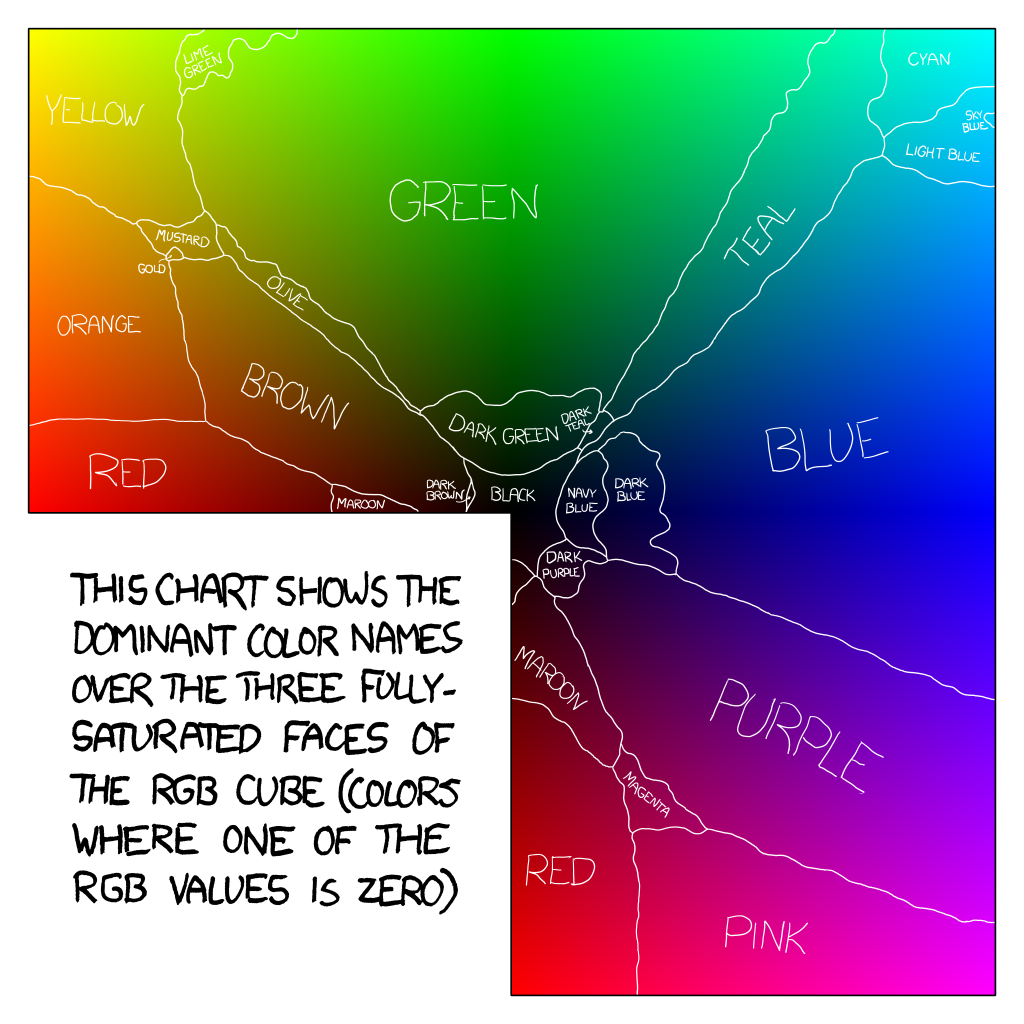
The data for this chart is here (3.6 MB text file with each RGB triplet named). Despite some requests, I’m not planning to make a poster of any of this, since it seems wrong to take advantage of all this volunteer effort for a profit; I just wanted to see what the results looked like. You’re welcome to print one up yourself (huge copy here), but keep in mind that print color spaces are different from monitor ones.
Basic Issues
Of course, there are basic issues with this color survey. People are primed by the colors they saw previously, which adds overall noise and some biases to the data (although it all seemed to even out in the end). Moreover, monitors vary; RGB is not an absolute color space. Fortunately, what I’m really interested in is what colors will look like on a typical monitors, so most of this data is across the sample of all non-colorblind users on all types of monitors (>90% LCD, roughly 6% CRT).
Color is a really fascinating topic, especially since we’re taught so many different and often contradictory ideas about rainbows, different primary colors, and frequencies of light. If you want to understand it better, you might try the neat introduction in Chapter 35 ofThe Feynman Lectures on Physics (Vol. 1), read Charles Poynton’s Color FAQ, or just peruse links from the Wikipedia article on color. For the purposes of this survey, we’re working inside the RGB space of the average monitor, so this data is useful for picking and naming screen colors. And really, if you’re reading this blog, odds are you probably—like me—spend more time looking at a monitor than at the outdoors anyway.
Miscellaneous
Lastly, here are some assorted things people came up with while labeling colors:

Thank you so much to relsqui for writing the survey frontend, and to everyone else who sacrificed their eyeballs for this project. If you have ideas and want to analyze these results further, I’ve posted the raw data as an SQLite dump here (84 MB .tar.gz file). It’s been anonymized, with IPs, URLs, and emails removed. I also have GeoIP information; if you’d like to do geocorrelation of some kind, I’ll be providing a version of the data with basic region-level lat/long information (limited to protect privacy) sometime in the next few days. Note: The ColorDB data is the main survey. The SatOnly data is the supplementary survey covering only the RGB faces in the map, and was presented on a half-black half-white background.)
And, of course, if you do anything fun with this data, I’d love to see the results—let me know at xkcd@xkcd.com.
 xkcd
xkcd 

Fucking hated this! Soooo much! It made me writhe in anger and despair! And what the hell is fuchsia? I’ve never heard that before in my life.
LikeLike
I got every one of these colors perfectly right. I just used my photoshop’s eyedropper tool and put in the appropriate #XXXXXX rgb value. You’re welcome for perfectly identifying each and every color each and every time, and for entering each one in a manner universally recognizable by internets everywhere
*bows*
LikeLike
I am curious what percentage of responders knew their monitor settings, etc.
LikeLike
Penis … is a color?
LikeLike
Interesting that salmon is a male color!!!
LikeLike
A different kind of color test.
http://www.xrite.com/custom_page.aspx?PageID=77
LikeLike
Looking at your mapping of the colors, it seems as though the larger regions represent colors that people are less sensitive to (considering there are huge swathes that they basically call the same color).
Could it be worthwhile to map the data onto a space where each color was given equal space, and by doing so giving each color that people care about equal weight? You could end up with a color palate that looks really odd but would be much more meaningful to the human eye/brain.
Additionally, you could do one of these mappings for chromosomal groups and maybe determine some sort of correlation that would imply some interesting causations.
LikeLike
Dang, you went through a lot of data!
LikeLike
I am so confused by this…
LikeLike
Thank you for doing this, although it’s value may be of some debate it looks like you did a really good job with it.
Kudos!
LikeLike
I thought this was hilarious. Free universally recognized colours every now and then would have hugely increased my enjoyment.
LikeLike
I hate you. Colours will never be the same 🙂
but haha, you had to analyse them all
all I had to do is mindnumbingly sit and name like 300 different colours. It was addictive 🙂
LikeLike
This is an amazing study. It’s really impressive the depths you went in to and the conclusions you drew from such seemingly simple input. This is why I love science.
LikeLike
Did anyone notice the Greasemonkey script to auto-populate the color name and complete the survey for you?
LikeLike
The Graphics Lab at Stanford University has come up with a pretty cool webpage about color theory, including human sensitivity functions, primaries and color matching, and other cool science behind color. The page is here: http://graphics.stanford.edu/courses/cs178-10/applets/locus.html .
LikeLike
We can safely state that “Teal” is a color recognized by men thanks only to Age of Empires.
LikeLike
This is very interesting.
LikeLike
I always used to have a hard time remembering how to spell fuchsia, until I read about the history of the word.
The colour name fuchsia refers to the colour of the flowers on the fuchsia plant. The genus (which contains dozens of pink- and/or purple-flowered species) was first identified in the Linnaean system by botanist Charles Plumier, who made a voyage to the “New World” around the turn of the eighteenth century for the purpose of identifying plants previously unknown to European “natural philosophy” as science was called in those days.
Plumier named the extravagantly pink-flowered plants after Leonhart Fuchs, an herbalist and professor of medicine, on whom he apparently had something of a man-crush.
So the plant’s name is fuchs+ia, pretty-man Leonhart’s surname plus a Latinate ending. Fuchsia is the genus name, and there are dozens of species without even counting the many hybrid varieties, but “fuchsia” is both the common name for plants in the genus, and the fairly-common colour name for a range of hues which overlaps somewhat with shades of pink called “hot pink” and “magenta” (which of course is not spelt magneta).
LikeLike
I love how men mention the color salmon, but women call it pink. Reminds me of that friends episode with the salmon colored shirt. You can find it on Youtube.
LikeLike
Out of curiosity, how many people entered hexadecimal color codes? I did about 10 like that. =P
LikeLike
Salmon – from the Crayola, and from everyone’s favourite HS teacher who thought he looked hot in it (Mine was a Mr. Innocente…and he was anything BUT)
Teal – From my favourite XP colour scheme, also known as Teal(VGA)
Captcha fun: verbal escaped … no more words, and no more promises..
LikeLike
I stopped around 200. I’ve spent every day since i took that test in rehab, and my sanity has been restored by the proper spelling of fushsia
LikeLike
One time I went to a middle school that painted the four halls four separate colors, one of which was salmon. So yeah, imagine going to class in a room with salmon walls.
Randall, we have not met, but this survey inspired me to notice the potentially “girly” way I do my physics diagrams.
http://writelhd.blogspot.com/2010/05/girly-isnt-derogatory-word.html
LikeLike
Salmon is a male color because a lot of guys feel that it is the only acceptable saturated pink for men’s business clothing.
LikeLike
Absolutely hilarious. And salmon is about as gay of a color for men’s clothing thats possible. There is nothing acceptable about it.
LikeLike
You know, according to your Google screen cap, the proper spelling IS fuschia, which is NOT like fuck-sia and actually IS present in people’s answers. Your statement about how nobody can spell it right is invalid, if we are accepting Google’s suggestion as the correct spelling.
However, Google’s suggestion is wrong. So I’m still confused as to how you finally figured out that it’s like fuck-sia if it weren’t for your friend… and for things like this, I’m not sure I’d trust a friend.
So what colors were penis, dunno, and wtf?
Great job, though! When will you publish?
LikeLike
Chare: The statement that nobody can spell “fuchsia” right is valid. That Google’s suggestion is wrong is a solid evidence to that statement. Not even Google can spell it right.
LikeLike
You should sell a poster and donate the profit to some charity for the [color]blind.
LikeLike
I’d like to know which color was most frequently identified as “WTF.”
LikeLike
This actually made me see random spots of colors for the rest of the night after I took it.
(It also helped me decide which color to paint my toenails.)
LikeLike
These results are more interesting than the actual test…I did it, but got so sick with the huge proportion of green to other colours that I may have skewed the results slightly by calling every green colour I saw either “light green” or “greeny-brown”.
LikeLike
I used to do closed captioning, and I HATED when people said the word “fuchsia.” I never learned how to spell it properly. I can’t even spell it close enough to get Google to suggest the correct spelling.
Fascinating study!
LikeLike
This is all a conspiracy anyway. Pantone changes the names every year. 😉 I thought male readers of XKCD would come up with something a little more creative? I’m not going to judge (I lie) though since my mom’s idea of fun was teaching me color’s off the color wheel and not the simple one. The one that fans out and has like 5 colors on each card and.. I just remember it was heavy at that age because there was so many glossy cards attached to it for my little child hands. Fuchsia is just cool because it’s FFOOFF and has always been one of my favorite words to say! And it helps give sunsets that je ne c’est quoi that makes women appreciate being in your arms at that moment along with salmon and indigo and burnt umber and canary yellow and periwinkle and lavendar and cornflower blue and… dammit mom! Ok, that last one I like because of Fight Club.
Huh.. huh.. my captcha says “head, rubying”
LikeLike
Fascinating insight. I spent a little while putting colo[u]r names in, very interesting to see chart of what colours namespace looks like.
LikeLike
Rofl! Only fskign hackers would spend so long discussing this in such tiny detail. Excellent stuff!! Think I may gather all the comments up and use as data for another study…dunno what I’ll call it tho’…
Captcha says “Legion graphite”. “Graphite” of course is also a colour which I dont believe I saw in your study. Oh, or is it because ‘graphite’ is a mix of black & white and some argue that those are not colours…this is doing my head in…
Well done on the study!!! Actually highly fascinating and I’ll be spending a wee while in here going through all your data. Are you making all of the comments that were put in as colours in the actual survey also available?
I’m gonna kick my pal into looking at the GeoIP data once you release that.
Cool, cool, but I really should go outside now and get some daylight.
Thanks for the fun!
LikeLike
“disproportionate numbers of greens” – actually that’s likely just a product of the fact we’re more sensitive to differences in the green part of the spectrum (unless you’re colour blind) so where purple, red, orange and yellow look like basically 4 different colours, greens and blues sort of mush together to make up hundreds more. What you’re registering is that “cool colours” making up half the spectrum do kind of all look vaguely green/blue, where “warm colours” seem to be divided up into more distinct colours.
Or, y’know, the randomiser’s a little warped and gave you a shedload of green.
LikeLike
There is one geo-related test I would be interested in that should be relatively easy: Japanese language users and blue/green. In Japanese the colour “aoi” is used for the blue in the sky … and also the green in traffic lights! Seriously. “Midori” is used for green as in grass.
So how about a specific column (with male/female responses) for respondents from the land of the rising sun?
LikeLike
I would be very interested to see a breakdown of what names people gave to various shades of gray/grey. Gray is of course the American spelling and grey the British spelling of what should be the same colour. Yet several people I know have independently come to use both spellings — not interchangeably, but rather to refer to different hues of the shades between black and white.
I’ve no idea how difficult it would be to determine whether individual participants used “grey” for some colours and “gray” for others. It’s possible some of those who did so simply made a typo, or used alternating spellings due to uncertainty as to the correct one.
Of the people I’ve known who use one spelling for some hues of gray/grey and the other spelling for distinctly and discretely different hues of grey/gray, however, nearly all came to divide the set of nearly-desaturated colours into the same two groups and to apply each spelling to the same set. In other words, within this group of people, one person’s grey is generally another’s grey, rather than being their gray. There’s virtually no other synaesthesia-type linkages among these people, but most of them I’ve discussed the matter with agree that the distinction they observe between gray and grey helps them to understand what synaesthesia must be like for those who do experience it more fully.
As far as I know, there hasn’t been any formal study of this phenomenon. So any data you could mine from your results would be very illuminating.
(Ah, and the comment by “-S” @ 6:36 am 8 May has reminded me to wonder about respondents whose native languages have a grue instead of or in addition to a green or blue, as well as respondents whose native languages differentiate dark and light blue, in the way English differentiates red from pink — instead of calling the latter light red.)
LikeLike
Thanks for the data. I did a 3D variant of the dominant surface colors:
http://blogs.sas.com/jmp/index.php?/archives/310-XKCD-Dominant-Color-Map-in-JMP.html
LikeLike
Very interesting stuff, does anybody else think that the larger variation of colour names in females may be somehow linked to the huge variety of make-up products in shops? I’ve read the names of different lipsticks/blushers, nova white? Passionate red? Space nerd green? i dunno, maybe girl’s enjoy reading dulux colour charts too much. White for me is white, but for one of my girl mates it could be off-white, pale cream, eggshell, milk white, starshine, coconut, pearl, tipex or even cold albino!
LikeLike