Update: I’m finally home after a month or so of nonstop events, including several xkcd book fund-raisers/signings. I met tons of cool people, we raised a lot of money for the EFF and Room to Read, and at one point I signed a book for a robot. Thank you to everyone who ordered a copy, by the way! I hope you like it. They’re shipping out nicely, and we’re about ready to order a second printing.
The events and travel were a huge amount of fun, and I loved getting to talk to (or at) so many of you cool people. But I’m an introvert at heart, and after doing that much socializing I feel a powerful urge to hide in my room for about a month. At some point in my travels I seem to have picked up a cold that’s been keeping me down for a couple days, so it’s just as well that I don’t have any more events on the immediate calendar. There’s no fever, so it’s not swine flu, but it’s keeping me awake at night and I’m going through a lot of tissues and cough medicine. But it should blow over in a couple days, and then I’ll get to spend a while quietly working on new projects!
While I’m doing that, here’s a bit about a neat book I found recently:

Physics for Entertainment:
Physics for Entertainment was written by Yakov Perelman in the 1920’s (in Russian) and updated periodically through the 1930’s. There are actually two parts to it, but Volume 1 is long out-of-print (though findable online — more on that later). The book I have is a 1975 translation of Volume 2. The book is a series of a few hundred examples, no more than one or two pages each, asking a question that illustrates some idea in basic physics.
It’s neat to see what has and hasn’t changed in the last century or so. Many of the examples he uses seem to be straight out of a modern high school physics textbook, while others were totally new to me. And some of the answers to the questions he poses seem obvious, but others made me stop and think. The diagram to the right shows a design for a fountain with no pump — it took me a while to get why it works. (For an easier-to-build variant, click here.) Later in the book, he explains the physics of that drinking bird toy.
It’s written in a fun, engaging, conversational style, as if he’s in the room chatting with you about these neat ideas.

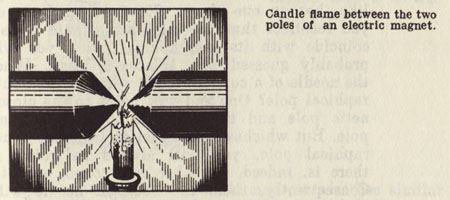
There are a lot of diagrams:

And it’s hard not to like the guy:

“If you’ll bear with me for a moment, let’s analyze this fairy tale from a physics standpoint …” That’s a man after my own heart.
He also spends a lot of time discussing why various perpetual-motion machines won’t work. it’s interesting to see that there was as thriving a community of free energy people a century ago as there is now, many of their designs based on the same misapplications of physics.
Lastly, when he talks about space travel — from a pre-space-age perspective — he turns starry-eyed and poetic:

I alternate wildly between thinking that it’s totally crazy that we clawed our way up out of the atmosphere and walked on the moon, and thinking that it’s a shame that it turned out to be so boring. But I really desperately want to see more missions to places like the Jovian moons. If it turns out one of them is teeming with life, we’re gonna feel awfully silly about how long we spent shuffling around in the Martian dust. Also, Kepler is really exciting, putting us in a much better place to speculate about life in the galaxy.
You can get the printed Volume 2 on Amazon, while Volume 1 was supposedly unavailable for translation or reprint. However, I mentioned this book at one of the events recently, and reader Matthias Kübel emailed me to let me know Volume 1 is available free online! I’m looking forward to reading through it.


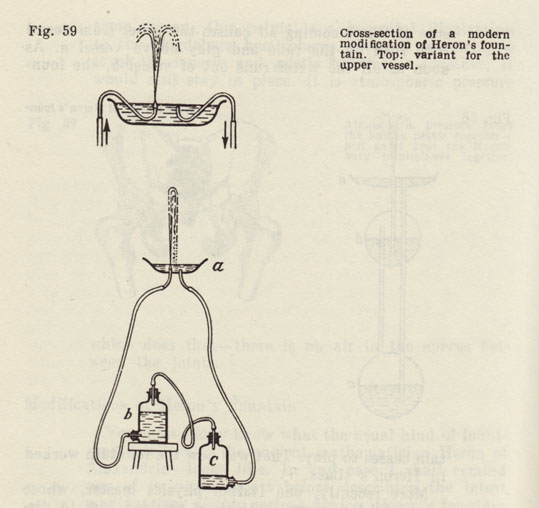
Heron’s fountain is a neat one, and relatively easy to construct too.
For best effect, try to make the lower container as far as possible (in height) from the upper container. This will give you more height on the fountain’s spray.
LikeLike
I have the first volume in russian for sure at home, with several other perelman books. I can’t promise to translate, but am willing to scan. 🙂 You can definitely see the pictures. 🙂
LikeLike
Ilia: Volume 1 is already available online — see the download link in my last paragraph.
LikeLike
I’ll be honest with you… I’m still trying to figure out why the fountain works. Is the “easier to build” variation helpful in understanding?
Could you give us non-physicists a hint? And I say that with a background in a -more- pure discipline, so I hope the question isn’t too self-effacing.
LikeLike
Jovian moons, eh?
Excepting Europa, right? Since we may attempt no landings there.
LikeLike
I get how the fountain works, I think – but if it does, is that not a perpetual motion machine? Presumably it slowly gets weaker and weaker until it just reaches some equilibrium and stops?
LikeLike
Rusty,
If I’m not mistaken, the way the fountain works is like this:
1. Water flows from Reservior A down to C.
2. As water flows into C, air is displaced into Reservoir B.
3. The resultant extra pressure from the increased amount of air in B forces the water in that chamber back up through the spout of the fountain, where it falls back down into A to start the process over again.
And the time the water takes to stream into the air and fall back down is just enough to ensure that the system won’t reach some kind of equilibrium state.
But, my background is in the soft subjects (marketing & business), so if someone with any better knowledge of physics can correct me, I’d be grateful.
LikeLike
rusty: The key to understanding the fountain is to not only consider the movements of the the water, but also considering the movement of the air (and remembering that all flasks are water-tight). It’s quite wonderful once you figure it out.
A hint: water flows from the basin (container a), to the lower flask (container c). What happens to the air in container c?
LikeLike
For you people thinking it’s a perpetual motion machine, it’s not. It can’t go on forever, the bottom container will eventually (pretty quickly) fill up. The water as a whole is moving downwards.
LikeLike
Glad your travels were so fruitful. Looking forward to hearing you on Skeptically Speaking tonight!
LikeLike
That kind of books gets old, and some of yesterday’s miracle seem like a child’s play for today’s people.
I don’t believe like Perelman that our future lies in outer space, but I’m excited to see if humanity can unite and manage Earth finite resources one day. That is the challenge of tomorrow.
LikeLike
Looking forward to your radio interview tonight! I already sent in my question. Anyone else who has one should go to skepticallyspeaking.com and submit one.
LikeLike
I agree with K.O…..You have a gift for storytelling, sir….Should be a good show tonight!
LikeLike
I think the more interesting question for fig. 145 is: If the bullet was covered in paint an left a trail on the end of the rotating barrel, what would the path look like. It certainly would not look like the dashed lines in the figure.would it be sinusoidal? would it curve more sharply at the ends than at the center? What would be an appropriate function to graph the path?
I may work on that last one myself.
LikeLike
I have my grandfather’s 1949 (13th edition) Estonian translations of these books and they are indeed awesome. They are one of the few books that I remember reading as a child.
Being old paperbacks, they are sadly in a state of disrepair with tattered covers and pages falling out. (Picture linked in my username.)
LikeLike
Both volumes can be downloaded from FreeBookSpot (freebookspot.in)
LikeLike
I’ve got both of them in Russian. Would you like one?
LikeLike
Anyone know where I can buy both volumes in Russian? Digital copy is nice, but I just can’t stand reading off the screen for too long.
LikeLike
@Seb, and anyone else downloading the copies at freebookstop.in are encrypted with a password
LikeLike
@Aramis and other people having problems with reading : of course there is a password, it’s to protect from automated scans. The password is indicated just next to the link.
LikeLike
I have a quite-but-not-really similar book on electricity and electrodynamics called ‘Die Elektricität im Dienste der Menschheit’ by Dr. Alfred Ritter von Urbanitzky. Written and published in 1885, it’s obviously full of mistakes but it has some truly wonderful illustrations that really makes you think about old problems in new ways and also shows some of the awesome things they built back then. The text is hard to read and understand, since it’s in german (I’m danish) and set in Fraktur[1] but it’s well worth the effort 🙂
[1] http://en.wikipedia.org/wiki/Fraktur_(typeface)
LikeLike
Haha, awesome. Analyzing fairy tales is ridiculous fun.
LikeLike
There is a Mathematics can be Fun by Perelman. Quite good, but not easily available.
LikeLike
Can’t wait to see you in a few minutes on Skeptically Speaking!
LikeLike
Thank you for answering my question about the robot, Randall! 😀
LikeLike
Well, volume 1 is definitely going on the Kindle!
LikeLike
Glad you liked the video, Randall 🙂
The even was awesome!
JF (the staring contest and weird French word guy)
LikeLike
Lewis Carroll Epstein’s “Thinking Physics” is similarly awesome. I think it’s the book I most enjoyed reading in my life.
LikeLike
My aunt had a copy of YI Perelma’s Fun With Physics and Maths. It was an awesome book, filled with colored pages, hard bound – everything needed to intrigue a child, apart from the marvellous content.
Those were the days of the Soviet Union, and books from Raduga and Mir publishers filled bookstores in India. They were really cheap (you could buy them for 20p to 3 rupees). The paper was awesome – I’ve never seen such kind of paper and binding in any Indian, American or British publication. The quality of the books is also awesome.
I also recommend to you Landau’s pamphlet titled “What is the Theory of Relativity”. Mir Publishers.
LikeLike
Analyzing fairytales? That strongly reminds me of Godel-Escher-Bach…
As for “Physics for Entertainment” – I downloaded the volume 1 via the link you gave, and indeed, it is a joy to read. Thanks!
LikeLike
I have both “Physics for Entertainment” as well as “Mathematics for Entertainment” by Perelman. They were gifted to me when I was in school, and they are a major reason why I fell in love with maths and physics. Perelman was truly a gifted writer.
LikeLike
if you’re one of those people that’s happier with a physical copy, it looks like abebooks.com has some. (useful book finding place to know about in general)
LikeLike
anyone having trouble with the pdf version of volume one? when i open it in snow leopard, preview freaks out and starts using up all my cpu cycles. never seen that happen with a pdf before, not even bigger ones than this.
LikeLike
I saw that fountain in a book when I was younger, but never figured out how it worked. (An equivalent but easier to construct design, to be precise.) It is quite clever…
LikeLike
Rereading the first book, I just remembered something from my childhood:
Those that have a copy, look at Fig. 41.
I did that. A lot.
I cut up dozens of postcards into small boomerangs and spent many a summer evening launching them. Just like shown in that drawing. I also remember creating quite a mess, with little paper boomerangs littering everywhere.
LikeLike
This book reminds me of Stick and Rudder by Wolfgang Langewiesche–a very accessible, well-written introduction to flight theory. He makes all sorts of references to “young men trying to impress girls by buzzing their houses” and such.
LikeLike
QUOTE:
I think the more interesting question for fig. 145 is: If the bullet was covered in paint an left a trail on the end of the rotating barrel, what would the path look like. It certainly would not look like the dashed lines in the figure.would it be sinusoidal? would it curve more sharply at the ends than at the center? What would be an appropriate function to graph the path?
END QUOTE
Assuming the bullet was traveling at a constant velocity, and the barrel was rotating at a constant angular velocity, the path would resemble the function r = x as graphed on a polar coordinate system. That is assuming that the bullet is traveling very slow and the barrel is rotating extremely quickly; in real life it would be a nearly straight line.
LikeLike
You might like “How Everything Works” by Louis Bloomfield. He examines every day situations and makes physics out of them, not unlike this book.
LikeLike
* Edit to above post
Also assuming that the bullet passes through the center of the circle; if it cuts a secant instead then the graph will be different.
And: repeaterly impulse?
LikeLike
Ah, Perelman! “Physics Can Be Fun” was de rigeur for Indian nerds back in the ’70s/’80s. Thanks to the Russian Connection, we had plenty of copies available and it remains one of my most cherished experiences. Gift-motion machines, stereoscopic vision…
I was shocked to discover that he died in Leningrad. I was hoping he’d still be around, a snowy-bearded Santa Claus who would be working out what it would take to deliver gifts to every child in the world…
LikeLike
Physicists use math to explain reality.
Mathematicians use math to escape it.
I believe this is your original quote, which I heard you say one evening.
LikeLike
I distinctly remember reading a news report that there were several cases of confirmed H1N1 with no fever somewhere, so there’d be some possibility of it being mutant feverless swine flu.
LikeLike
This is completely unrelated to your post but I’ll say it anyway cause I’m a dick’.
One day when you can be bothered can you make a comic with Mark Shuttleworth as a super hero with a cape and an Ubuntu logo tattooed on his oh-so-manly chest?
Cause that would just make my day.
PS: I love you, no really, I do.
LikeLike
a fountain that perpetually pumps water upwards? I wish to invest large sums of money in the development if this idea.
LikeLike
Welcome back! For a primarily English and language geek, I’m surprised how easily I understood that fountain. I’d totally make one – perhaps I’ll take it up with my science geek friends.
Please keep printings of the xkcd book rolling out, because I know I want one and I have not had the chance (or the money) to get one yet.
LikeLike
Hey, I actually red the book when I was a child! (I grew up in the USSR)
LikeLike
Hey! Surely your reverse polish sandwich is the wrong way round? Assuming the sausage is a data item, and the bread is an operator you apply to it, then reverse polish would have the sausage first (gets stacked), then the bread (pops top item off stack and is applied to it).
What you have there, my friend, is a lisp sandwich:
(bread (cons sausage mustard))
LikeLike
The man died on March 18th 1942 of starvation during the blockade of Leningrad. His wive died two months earlier, also of starvation.
He would have written more books! 😦
LikeLike
I found the diagram on wikipedia easiest to understand:

For some reason the square containers makes it easier for me to imagine the air pushing on the water.
LikeLike
If it was cheap and safe Space travel wouldn’t be boring, we’d all already be able to take trips to the moon, people might be even living there while we try to terraform Mars.
Sadly it’s too costly, and nobody will really try to change that until we start running out of key resources here and recycling them is more costly than flying into space and mining asteroids.
LikeLike